How to Use Call Recordings to Build a Sales Coaching Loop That Actually Improves Conversion
The most common reason Indian SME sales managers give for not coaching their agents is time. The second most common reason is that they have nothing concrete to point to. Both problems are solved by call recording. The manager who has 10 recordings from last week can run a 20-minute coaching session with specific timestamps and specific fixes. The manager without recordings is guessing.
The other reason coaching gets skipped is that it feels vague. Telling an agent to be more confident or listen better is not actionable. Telling an agent that at 2 minutes 40 seconds they moved straight past an objection that needed to be addressed is specific and fixable. The recording is what makes the difference between one kind of feedback and the other.
How Calliyo records calls without VoIP
The standard concern with call recording for SIM-based teams is that SIM calls are hardware calls, not data calls, so there is nothing to intercept at the software layer. This is true for older recording approaches.
Calliyo records calls at the device level using the Android telephony API. When a call is made or received through the Calliyo app, the system captures the audio at the device layer, not the network layer. The recording stores locally on the device during the call and uploads to the CRM when connectivity is available. The result: every call is recorded, with no dependency on VoIP, no third-party gateway, and no degradation to call quality.
For managers, the recording is attached to the call record in the CRM alongside the disposition, duration, and lead details. You can play it back from the dashboard without switching to another tool.
The coaching loop that actually moves numbers
Most coaching either happens too infrequently (quarterly reviews) or too reactively (only after something goes wrong). The loop that consistently improves conversion rates runs weekly and follows a fixed structure.
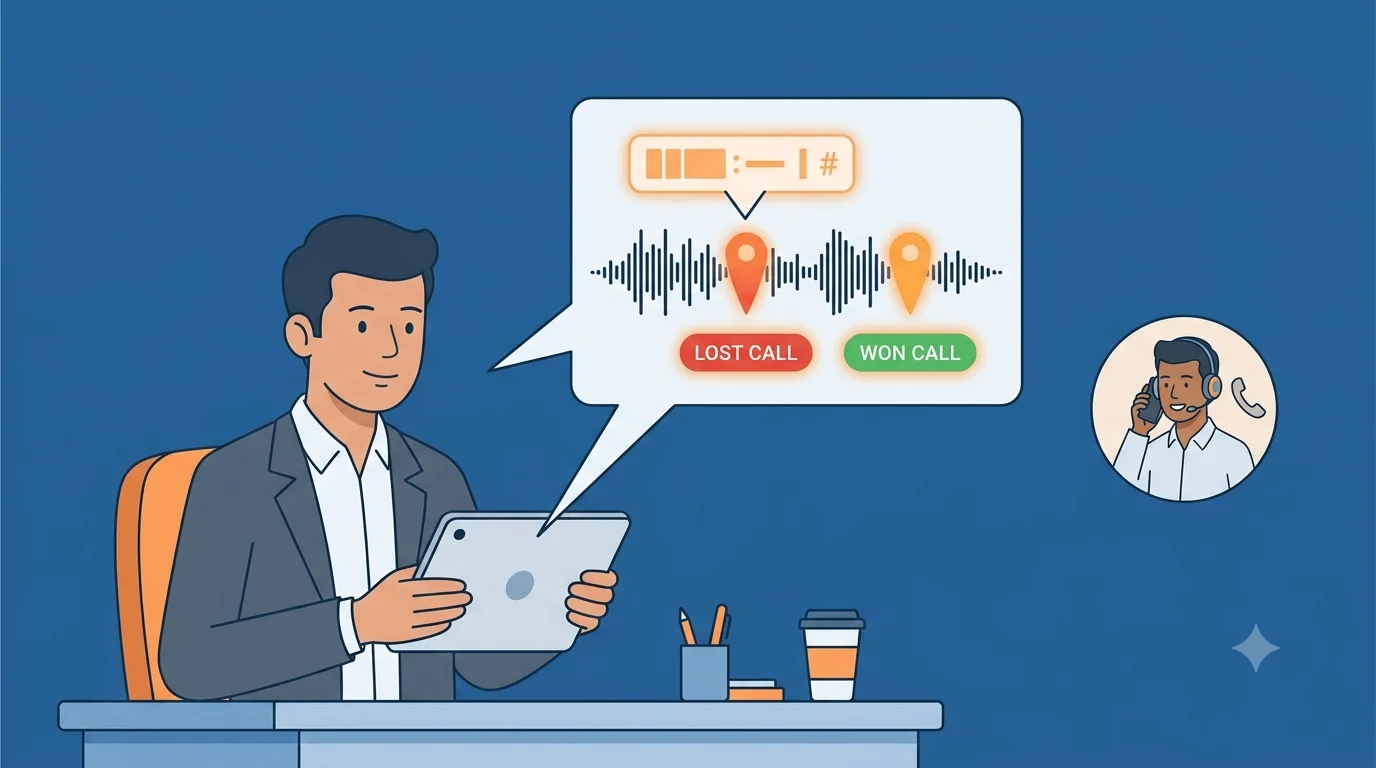
Step 1: Select two recordings per agent per week. One converted call and one lost call. The contrast is what makes the coaching valuable. You are not looking for everything that went wrong. You are looking for the patterns that separate the win from the loss.
Step 2: Listen for three things in each recording. Where did the agent lose control of the conversation? Where did they miss or misread an objection signal? Where did they rush past a moment that deserved more time? In the won call, flip the question: what did they do at that moment instead?
Step 3: Give one specific fix, not five. Agents absorb one change per week. The feedback should be referenced to a timestamp and framed as a specific alternative: at 3 minutes 10 seconds, the customer said they need to think about it, you moved straight to price. Next time, pause and ask what specifically they want to think through. That is actionable. Being more patient is not.
Step 4: Check the following week. Did the agent apply the fix? Did it move the conversion on similar calls? If yes, reinforce it and move to the next pattern. If not, understand whether it was a skill gap or a situational mismatch and adjust.
Four weeks of this loop is typically enough to see measurable movement in an agent's conversion rate if the coaching is specific and the feedback is being absorbed.
Using recordings for onboarding new agents
New agents who listen to 10 recordings from top performers before their first live call outperform agents who go straight into live calling. The reason is simple: they have heard how the conversation flows, how objections sound in real Indian sales contexts, and how the best agents handle the moments where the call could go either way.
Build a library of your 20 best recordings: five from different language clusters, covering different product objections and different customer profiles. Update it quarterly. Every new agent listens to all of them in week one before making their first call. This single change reduces the time to full productivity by one to two weeks in most teams.
Group coaching with anonymised recordings
Once a month, run a 30-minute group session where you play one anonymised recording and ask the team to diagnose it before you say anything. What went well? Where was the missed opportunity? What would you have said at that moment?
Agents who critique a recording themselves absorb the lesson far more than agents who are told the same thing by a manager. The anonymisation matters because agents need to feel safe saying something went wrong. If they know whose call it is, they will be polite instead of honest.
These sessions also surface patterns the manager may not have noticed. Agents on the floor often know exactly why a particular objection is losing deals. The recording session gives them a forum to say so.
Call recording and DPDP compliance
Under India's Digital Personal Data Protection Act, recording a call without informing the other party creates legal exposure. The practical fix is a pre-call IVR or announcement: a brief automated message at the start of the call saying the call may be recorded for quality purposes. Most Indian customers are familiar with this from banking and telecom interactions and do not object.
For outbound calls where no IVR plays before the agent connects, the agent can state at the opening that the call is being recorded. Build this into the script opening: a single sentence, always said, before the pitch begins. It protects the company and signals professionalism to the customer.
Recordings stored in Calliyo are tied to the lead record, accessible only to agents and managers with CRM access, and are not shared externally. This satisfies the storage and access requirements under current DPDP guidance for internal quality management use.
The metric that tells you coaching is working
Track conversion rate per agent on a four-week rolling basis. After four weeks of weekly coaching, an agent who started at 6 percent should be at 8 to 10 percent if the coaching was specific and the feedback was applied. If conversion has not moved, either the coaching is not reaching the actual failure point or there is a product or lead quality issue masking the improvement.
The secondary metric is average call duration on converted calls. Agents who are building trust correctly tend to run slightly longer winning calls than agents who are rushing to the close. If coaching is working, you will typically see both conversion rate go up and average duration on won calls increase slightly.
If your team is making calls that are not being recorded, you are coaching blind. Start the Calliyo trial, turn on recording, and spend the first week listening to what is actually happening on your team's calls. Most managers are surprised by what they hear.
Frequently asked questions
Does call recording work on SIM-based calls, not just VoIP?
Yes. Calliyo records at the device level using the Android telephony API, which captures audio from SIM-based calls directly on the phone. The recording is stored locally and uploaded to the CRM when the device has connectivity. No VoIP is required and call quality is unaffected.
Is recording customer calls legal in India?
Yes, with disclosure. Under Indian law and DPDP Act guidance, recording calls for quality and training purposes is permissible when the other party is informed. A brief statement at the start of the call saying the call may be recorded for quality purposes is standard practice and sufficient for compliance in most B2B and B2C contexts.
How many recordings should a manager review per week?
Two per agent: one converted call and one lost call. For a team of 15 agents, that is 30 recordings per week. At five minutes of listening per recording, that is two to three hours of review time, spread across the week. Most managers find this manageable when recordings are organised by agent and accessible directly from the CRM dashboard.
How do you prevent agents from gaming the system by behaving differently when they know they are being recorded?
Recording every call, not selective calls, removes the incentive to perform only on flagged calls. When agents know every call is recorded, they adjust their baseline behaviour rather than trying to identify which calls are being monitored. After two to three weeks, the awareness of recording becomes background noise and normal behaviour resumes.
Can recordings be shared with agents for self-review?
Yes. Agents can access their own recordings in Calliyo, which enables self-coaching between manager sessions. Many managers find that asking agents to identify one thing they would do differently in a recording before the coaching session leads to better quality conversations than reviewing recordings the manager identified alone.
How long are call recordings stored in Calliyo?
Recordings are stored in the CRM attached to the call record. Retention is configurable by the company admin. Most teams keep recordings for 90 days, which is sufficient for coaching cycles and any dispute resolution purposes. Older recordings can be archived or deleted based on your data retention policy.