
Lead Management System for SIM-Based Cold Calling: How Indian Teams Work High-Volume Lists Without VoIP
Cold calling in India has a VoIP problem. When a contact receives a call from an unfamiliar number with a non-local or virtual operator prefix, the probability that they answer drops significantly. Indian mobile users have become accustomed to screening calls from numbers they do not recognise — and the patterns that trigger screening are precisely the patterns that VoIP cold calling generates: unknown prefixes, numbers that do not resolve to any known contact, and area codes that do not match the caller's claimed location.
SIM-based cold calling sidesteps this problem entirely. A call made from a Jio, Airtel, or Vi SIM appears on the recipient's screen as a standard Indian mobile number — the same type of number they receive from colleagues, vendors, and family members. The visual trigger for call screening is absent. Answer rates on SIM-based cold calls in India are meaningfully higher than on comparable VoIP cold calls, and the difference compounds over a full campaign: a team generating 15 percent more connections per 100 attempts, sustained over a list of 5,000 contacts, produces a materially different number of qualified leads.
But the calling architecture is only part of the cold calling system. The other part — the part that determines whether a SIM-based team's higher connection rates translate into qualified pipeline — is the lead management system that feeds the dialer. How the list is organised, how calls are queued, how attempts are sequenced across the list, and how the system handles the compliance requirements of TRAI-regulated outbound calling are all lead management decisions, not calling decisions. Getting the calling architecture right while leaving the lead management to a spreadsheet produces a team that connects well but converts inefficiently.
Why SIM-based calling outperforms VoIP for cold outreach in India
The answer rate advantage of SIM over VoIP in Indian cold calling comes from three overlapping factors.
Number recognition and trust. Indian mobile numbers follow predictable patterns — 10-digit numbers beginning with 6, 7, 8, or 9, associated with known operators. A number that fits this pattern and belongs to a familiar operator (Jio, Airtel, Vi, BSNL) reads as a standard call. A VoIP number that does not fit the pattern, or that resolves to a virtual number service, reads as a potential spam or scam call. In the context of cold calling — where the recipient has no prior relationship with the caller — the marginal difference in number presentation is often the difference between an answered call and a declined one.
Network reliability across India's variable connectivity landscape. VoIP call quality depends on data connection stability. A cold call on VoIP that drops mid-conversation, experiences audio delay, or has echo or clipping is not just a poor experience — it is often perceived as a sign that the call is automated or fraudulent. A SIM-based call routes through the mobile network and delivers audio quality identical to any other phone call, regardless of the data signal at the caller's location. For cold calling teams operating from tier-2 and tier-3 cities, or from locations with variable broadband, SIM-based calling eliminates a quality variable that VoIP cannot.
TRAI compliance posture. TRAI's Telecom Commercial Communications Customer Preference Regulations require commercial outbound calls to originate from registered telemarketer numbers. SIM-based calling through a compliant system, where the business registers its numbers appropriately, aligns with this requirement more straightforwardly than VoIP architectures that route calls through multiple network layers. For companies calling from a small, defined set of business SIM numbers, the compliance documentation is simpler and the risk of TRAI-triggered complaints is lower.
What a lead management system for cold calling needs to do
A lead management system for SIM-based cold calling has a different job from a warm-lead CRM. Warm-lead management is primarily about individual lead journeys — routing a specific lead quickly, following up at the right time, tracking the relationship through a multi-touch sales process. Cold list management is primarily about campaign execution — working a bounded list systematically, managing attempt sequences, and producing clear qualified/disqualified outcomes for every contact in the list.
List ingestion and systematic queue distribution. Cold lists arrive as CSV files from purchased databases, industry directories, or internal prospecting. The lead management system needs to import these lists and distribute contacts to agent queues in a controlled order — not randomly, not by agent self-selection, but systematically, ensuring that every contact is reached before high-probability contacts are re-attempted and that agents are not cherrypicking the contacts that look easiest.
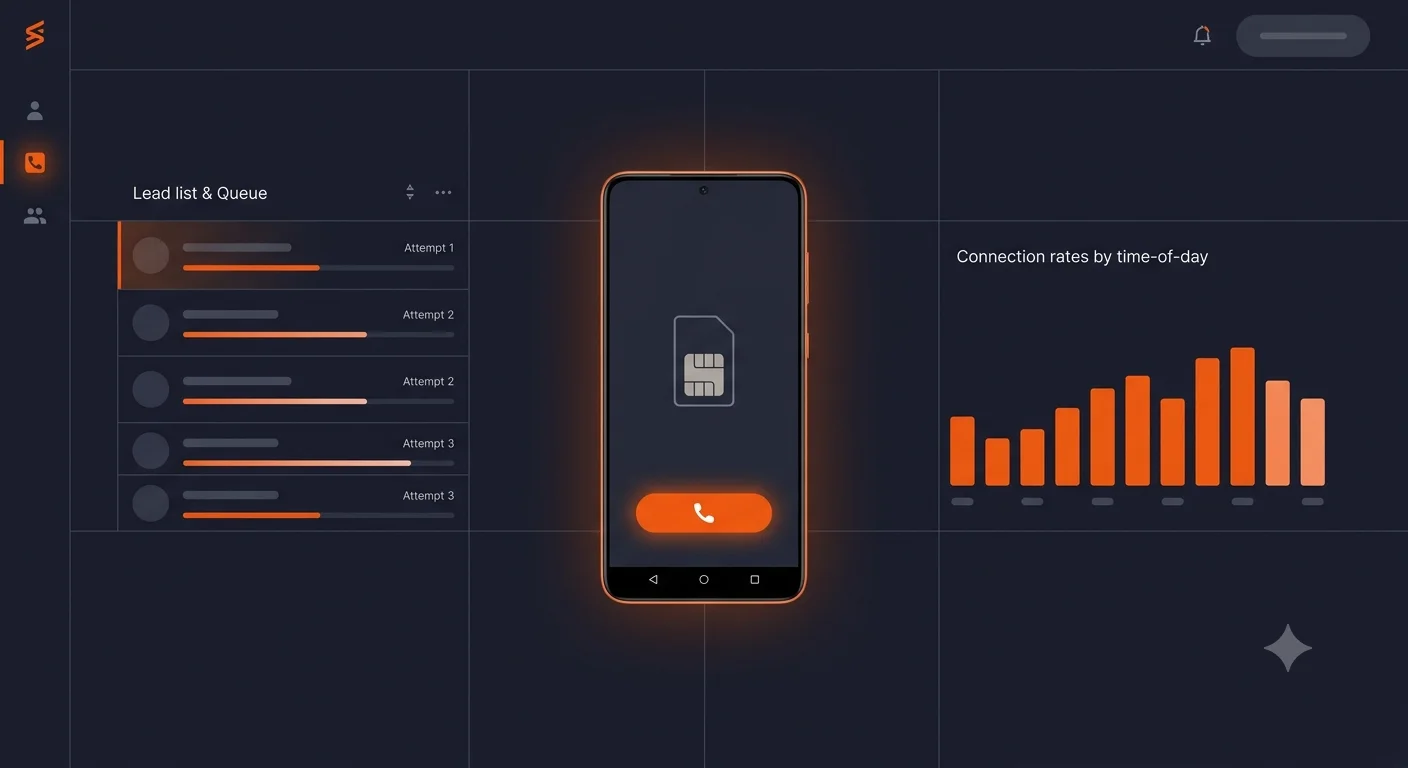
Queue distribution logic for cold calling typically prioritises contacts by segment and attempt count: first-attempt contacts first, distributed evenly across the agent team; then second-attempt follow-ups for contacts not reached on the first pass; then third-attempt retries; and so on until the attempt cap is reached and the contact is retired from the active queue. This structure prevents the common cold calling failure where agents concentrate on a subset of the list and leave the rest untouched until the campaign deadline.
Multi-attempt sequencing with time-of-day logic. A cold contact who does not answer on Monday at 10 AM should not receive their second attempt at 10:15 AM on the same Monday. The second attempt should come at a different time of day — ideally at a time when the contact segment has shown historically higher answer rates. A B2B contact at a small business is typically more reachable between 10 AM and 12 PM and again between 4 PM and 6 PM. A consumer contact may be more reachable in the evening. The lead management system should allow attempt scheduling rules that space attempts across different time windows rather than clustering all attempts in the same session.
Fast disposition that feeds attempt logic. After each call, the agent selects a disposition — Connected and Qualified, Connected and Not Interested, No Answer, Busy, Wrong Number, Gatekeeper. This selection is not just for reporting; it feeds the attempt logic directly. A No Answer on a first attempt schedules a second attempt at a different time. A Wrong Number retires the contact from the queue immediately. A Gatekeeper disposition might schedule a callback at a time when the decision-maker is more likely to be reachable directly. The system needs to translate disposition choices into queue actions automatically — without the agent or manager manually managing the attempt schedule.
Attempt cap enforcement. Every cold contact should have a maximum attempt limit — the number of call attempts after which the contact is retired from the active queue and marked as Unreachable. Without an enforced cap, agents either over-invest in individual contacts (repeatedly calling the same numbers while leaving the rest of the list untouched) or make inconsistent decisions about when to give up. The cap should be configurable by list type — B2B contacts might warrant 4 to 5 attempts; consumer contacts from a purchased database might be capped at 3.
Manager campaign view, not just agent activity view. Cold calling campaign management requires a different dashboard perspective from warm-lead management. The manager needs to see campaign-level metrics — list coverage (what percentage of contacts have been attempted at least once), attempt distribution (how many contacts are at attempt 1, 2, 3), connection rate by segment and time-of-day, and qualified contact rate by list source. These metrics tell the manager whether the campaign is on track to cover the full list by the campaign end date and whether the list quality is producing results worth the calling effort.
Integrating SIM calling with the lead management system
The operational advantage of SIM-based calling is only fully realised when the call is made from within the lead management system rather than from a separate phone. When calls are made from within the system, the timestamp, duration, and connected/not-connected status are logged automatically the moment the call ends. The disposition screen opens immediately after the call. The next contact surfaces automatically based on the queue logic.
When calls are made from a personal phone — even with SIM — the lead management system has no knowledge of the call. The agent logs it manually after the fact, with the accuracy and completeness problems that manual logging always produces under volume pressure. The campaign-level metrics the manager needs — coverage rate, attempt distribution, time-of-day connection patterns — are only as accurate as the manual logs, which means they are not accurate enough to drive campaign decisions.
The integration requirement is simple in principle: the agent opens the contact in the lead management system, taps to call from the same interface, and the system places the call via the agent's SIM. The call routes through the mobile network — retaining all the answer rate advantages of SIM calling — while the system captures complete call data automatically. After the call, the agent selects the disposition in a 30-second screen, and the system updates the queue logic accordingly.
TRAI compliance in SIM-based cold calling systems
TRAI's TCCCPR regulations govern commercial outbound calls in India. The key operational requirements for cold calling teams are: calls must be made only between 9 AM and 9 PM, calls must not be made to numbers on the DND registry without explicit consent, and calls must originate from numbers registered as telemarketers with the relevant operator.
A lead management system for cold calling should enforce the calling hours rule automatically — blocking outbound calls outside the permitted window without requiring the agent to check the time. DND scrubbing — removing numbers on the DND registry from the list before the campaign starts — should happen at list import rather than being left to agents or managers to manage manually. These compliance controls protect the business from TRAI complaints and from the reputation damage of being flagged as a spam caller, which can affect answer rates on future campaigns if the number is blacklisted.
How Calliyo handles SIM-based cold calling campaigns
Calliyo supports cold list imports via CSV with systematic queue distribution across the agent team. Agents call from within the app using their Android SIM — calls route through the mobile network and appear as standard Indian mobile numbers. Every call is logged automatically. The disposition screen opens after each call and takes under 30 seconds. Attempt sequencing and queue prioritisation are managed by the system, not by individual agent decisions.
The manager's dashboard shows campaign-level coverage and agent activity in real time — how much of the list has been attempted, how many contacts are at each attempt stage, which agents are on track, and which time windows are producing the best connection rates for the specific list in the current campaign.
For teams running both warm-lead follow-up and cold list campaigns simultaneously, Calliyo manages both in the same agent queue with priority rules that keep time-sensitive warm leads ahead of cold list contacts — ensuring that cold campaign coverage does not come at the expense of warm-lead response time.
If your team is running cold calling campaigns from spreadsheets and personal phones, the gap between your connection rate and what SIM-based calling with proper list management could produce is measurable within the first week of a structured campaign. Start a Calliyo trial with your next cold list import and compare connection rates, coverage rates, and qualified contact rates against your current campaign benchmarks.
Frequently asked questions
Why do SIM-based calls get better answer rates than VoIP for cold calling in India?
SIM-based calls appear on the recipient's screen as standard Indian mobile numbers from familiar operators (Jio, Airtel, Vi), which are not visually distinguished from calls from known contacts. VoIP numbers often have unfamiliar prefixes, virtual number patterns, or non-local area codes that Indian mobile users have learned to screen as potential spam. The difference in number presentation directly affects whether a cold call is answered before any conversation begins.
What is the difference between lead management for cold calling versus warm-lead CRM?
Warm-lead CRM manages individual lead journeys — routing a specific lead quickly, following up at the right time, tracking the relationship through a multi-touch sales process. Cold list management is about campaign execution — working a bounded list systematically, enforcing attempt caps, sequencing retries across different time windows, and producing clear qualified or disqualified outcomes for every contact. The metrics, queue logic, and manager visibility requirements are different for each.
How many times should a cold contact be attempted before being marked unreachable?
For B2B cold contacts in India, 4 to 5 attempts spread across different times of day is a typical cap. For consumer contacts from purchased lists, 3 attempts may be sufficient before the probability of a productive connection drops below the cost of the attempt. The right number depends on the list source and should be validated by tracking at what attempt number successful connections stop occurring in your specific list type.
What TRAI compliance requirements apply to cold calling in India?
Under TRAI's TCCCPR regulations, commercial outbound calls must be made only between 9 AM and 9 PM, must not target numbers on the DND registry without explicit prior consent, and must originate from numbers registered as telemarketers with the relevant operator. A lead management system for cold calling should enforce calling hour restrictions automatically and support DND scrubbing at list import.
Why does calling from within the lead management system matter for cold campaigns?
When calls are made from within the lead management system via SIM, every call is logged automatically — timestamp, duration, connected or not — and the disposition is captured immediately after each call. This produces complete, accurate campaign data for coverage tracking and attempt distribution analysis. When calls are made from personal phones with manual logging, the data is incomplete and the campaign-level metrics the manager needs are unreliable.
Can a lead management system handle both warm portal leads and cold list campaigns at the same time?
Yes, with proper queue prioritisation. Warm portal leads are time-critical — every minute of delay reduces the first-call advantage. Cold list contacts need systematic coverage but are not time-critical in the same way. A lead management system that handles both should prioritise warm leads at the top of the agent queue and sequence cold list contacts around them, ensuring warm-lead response time is not sacrificed for cold campaign coverage.