
The Real Cost of Running a Centralised Call Center in India (And How Going Distributed Cuts It)
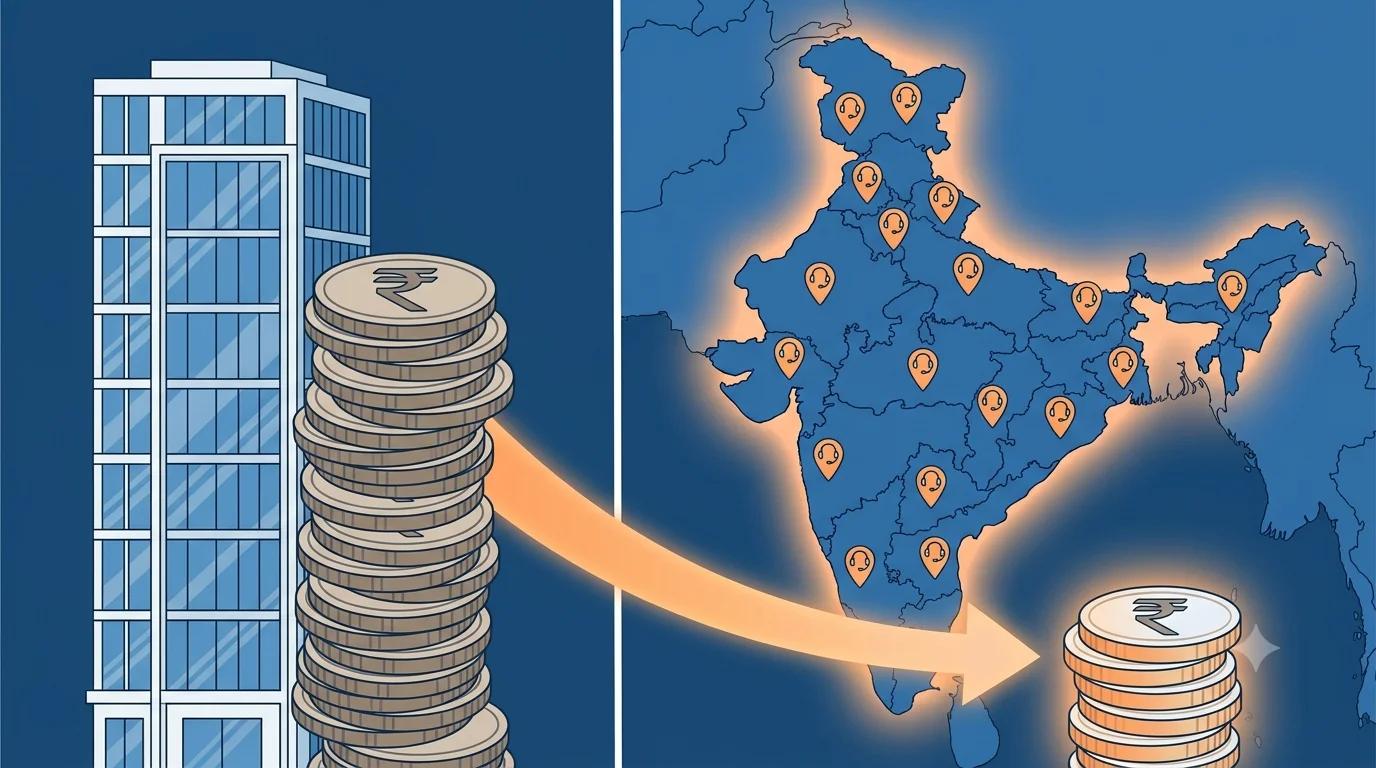
When founders and sales managers calculate the cost of their call center, they usually add up salaries and rent and stop there. Those two numbers undercount the real figure by 40 to 60%. The costs that do not make it onto the monthly P&L - attrition, retraining, productivity gaps during ramp-up, and the opportunity cost of operating in the wrong language market - are often bigger than the rent.
This post is a full cost breakdown for a centralised metro call center seat in India, compared against a distributed tier-2 model. The numbers are estimates based on market data, not accounting for your specific city or team, but they are close enough to run a real comparison against your own situation.
The per-seat cost of a centralised metro call center
Consider a 20-agent team based in a mid-range commercial office in Mumbai or Bengaluru. Here is what each seat actually costs per month:
| Cost item | Mumbai/Bengaluru estimate (per seat/month) |
|---|---|
| Commercial rent (per seat allocation) | Rs 8,000 - 15,000 |
| Agent salary (entry to mid-level) | Rs 18,000 - 30,000 |
| Employer PF + ESIC | Rs 3,000 - 5,000 |
| Power + internet (per seat share) | Rs 1,500 - 2,500 |
| Hardware amortisation (desktop/headset) | Rs 800 - 1,200 |
| Office admin overhead (per seat share) | Rs 1,000 - 2,000 |
| Direct monthly cost per seat | Rs 32,300 - 55,700 |
At the midpoint, a centralised metro seat costs roughly Rs 43,000 per month before the hidden costs that almost no one tracks.
The hidden costs that change the real number
Attrition. Indian call center attrition in metro cities runs 30 to 45% annually. For a 20-agent team, that means replacing 6 to 9 people every year. Each replacement costs roughly Rs 15,000 to 25,000 in recruitment (job board fees, agency fees, or internal recruiter time), plus 4 to 6 weeks of reduced productivity while the new hire ramps. At 30% attrition and a Rs 20,000 replacement cost per person, a 20-agent team spends Rs 1.2 lakh per year just replacing the churn - Rs 10,000 per seat per year, or about Rs 830 per seat per month added to your real cost.
Ramp-up productivity gap. A new agent in a centralised call center typically reaches 70% of their steady-state conversion rate by week three and full capacity by week five or six. During those five weeks, you are paying a full salary for partial output. For a Rs 24,000/month agent, that is roughly Rs 8,000 in productivity shortfall per hire. Spread across 6 replacements per year on a 20-agent team, that is Rs 48,000 per year - Rs 2,400 per seat per year.
Language mismatch drag. This is the hardest cost to measure but often the largest. A centralised team in one city, fluent in one or two language variants, calling customers across 10 states, is generating conversion rates well below what a language-matched agent would produce for the same lead. If your national average conversion rate is 8% and your Tamil Nadu leads are converting at 3% because your agents do not speak Tamil, you are leaving 5 percentage points on the table for every Tamil Nadu lead. At any meaningful Tamil Nadu lead volume, this is a larger number than your monthly rent.
The per-seat cost of a distributed tier-2 model
Now consider the same 20-agent team structured as distributed agents across five tier-2 cities: four agents each in Lucknow, Nagpur, Coimbatore, Rajkot, and Bhubaneswar.
| Cost item | Tier-2 distributed estimate (per seat/month) |
|---|---|
| Agent salary (entry to mid-level, tier-2 market) | Rs 12,000 - 20,000 |
| Employer PF + ESIC | Rs 2,000 - 3,500 |
| SIM card (company-issued, usage plan) | Rs 400 - 700 |
| CRM software (Calliyo, per seat) | Rs 400 - 800 |
| Device contribution (phone allowance amortised) | Rs 500 - 800 |
| Internet stipend (if agent is home-based) | Rs 500 - 800 |
| Direct monthly cost per seat | Rs 15,800 - 26,600 |
At the midpoint, a distributed tier-2 seat costs roughly Rs 21,000 per month - about half the metro centralised cost.
A worked example: 20 agents, two models
| Centralised Mumbai | Distributed tier-2 | |
|---|---|---|
| Direct monthly cost (20 agents) | Rs 8.6 lakh | Rs 4.2 lakh |
| Attrition + ramp cost (annualised, per month) | Rs 87,000 | Rs 30,000 |
| CRM software (already included in distributed) | Rs 16,000 | Rs 0 (included above) |
| Total monthly cost | Rs 10.03 lakh | Rs 4.5 lakh |
The distributed model costs Rs 5.5 lakh less per month on a 20-agent team. Over 12 months, that is Rs 66 lakh.
Why attrition is lower in distributed tier-2 teams
Metro call center attrition is high for structural reasons: agents are often young people who relocated from other cities, have high cost-of-living pressure, and see better metro opportunities as soon as they have a year of experience. Tier-2 agents working in or near their home city have lower cost-of-living pressure, stronger local roots, and fewer comparable opportunities pulling them away. Attrition in well-run distributed tier-2 teams is typically 12 to 20% annually, compared to 30 to 45% in metro centralised centers.
Lower attrition has a compounding effect: agents stay longer, build more product knowledge, and reach higher conversion rates over time. A 2-year agent consistently outperforms a 6-month agent on conversion. Metro attrition prevents you from accumulating this compounding effect.
The quality argument: distributed does not mean lower quality
The objection most founders raise to the distributed model is that remote agents are harder to manage and therefore produce lower quality. The data from teams that have structured distributed operations properly points the opposite direction.
When the agent speaks the customer's language natively, calls from a local SIM number, and has the cultural context to read the customer's signals correctly, the conversion rate goes up. When the CRM handles follow-up reminders automatically and gives supervisors real-time visibility across all locations, quality gaps get caught faster than they would in a physical office where problems can hide for days.
The distributed model only produces lower quality when it is set up badly - without proper routing, without call recording for coaching, without real-time dashboards, and without workflow automation. With those elements in place, the quality ceiling is the same as a centralised team and the language fit is higher.
Break-even and payback period
If you are transitioning from centralised to distributed, you will have overlap costs during the transition: you may be paying metro office lease for several months while building out the distributed team, and there is productivity loss during the changeover period. In most transitions, the fully-loaded break-even on the transition investment (lease overlap, hiring in new markets, new hardware) is five to eight weeks after the distributed team is at full operating capacity.
Beyond break-even, the savings compound monthly. Rs 5 to 6 lakh per month in cost difference on a 20-agent team is not a one-time saving. It recurs every month, while the language-match improvement drives higher conversion rates that improve revenue on the same lead volume.
If you are running a centralised metro call center and want to model what the distributed version would look like for your team size, start the Calliyo trial. The SIM-based calling, real-time dashboard, and workflow automation are what make the distributed model operationally viable without the quality trade-off that undid earlier attempts at remote call center operations.
Frequently asked questions
Are tier-2 city agents actually as capable as metro agents?
Sales ability is not a function of the city you live in. The specific advantage tier-2 agents bring is language and cultural fit for their local market. An agent in Nagpur who speaks Marathi and understands Vidarbha cultural norms will outperform a Mumbai-based agent calling into Nagpur, independent of education level. Hire for sales aptitude first; the local fit comes with the geography.
How do you maintain quality control without a physical office?
Call recordings reviewed weekly, real-time dashboards showing activity and conversion rates by agent, and workflow automation that handles follow-up compliance. The visibility in a well-configured CRM is higher than what a floor supervisor can maintain in a physical office. Problems surface faster because they show up as data deviations, not as something a manager has to walk past and notice.
What happens if we are still locked into a metro office lease?
Start hiring distributed agents while the lease runs out. Run both in parallel until the lease ends. The distributed agents' productivity data during the overlap period will give you concrete comparison numbers to justify the full transition to yourself and any stakeholders. Most teams that run this comparison are surprised by how quickly the distributed agents match centralised performance.
Does the cost saving hold for smaller teams, say 5 to 10 agents?
The per-seat savings are the same regardless of team size. The fixed infrastructure cost difference (metro office vs no office) is actually proportionally larger for smaller teams because they cannot spread overhead across as many seats. A 5-agent centralised metro team often pays a disproportionately high rent-per-seat if they are in a commercial space with a minimum lease size.
Is SIM-based calling required for the distributed model to work, or can we use VoIP?
You can technically use VoIP in a distributed model, but you lose the two biggest advantages for Indian SMBs: the local area code effect (higher answer rates when the number is local) and the reliability advantage in tier-2 and tier-3 markets where VoIP audio quality degrades. SIM-based calling is what makes the distributed model work well in the markets where most of the cost savings are generated.
How do we handle payroll and compliance for agents in multiple states?
Agents employed in different states fall under that state's labour laws for minimum wage floors and some benefits. This is manageable with a basic HR setup and is a normal requirement for any company with a multi-state team. The payroll complexity is worth the cost savings and conversion improvement for any team above 8 to 10 agents. Many Indian SMEs use a payroll service or EOR for multi-state agent teams to keep this simple.