
Centralised vs Distributed Call Center: Which Works Better in India?
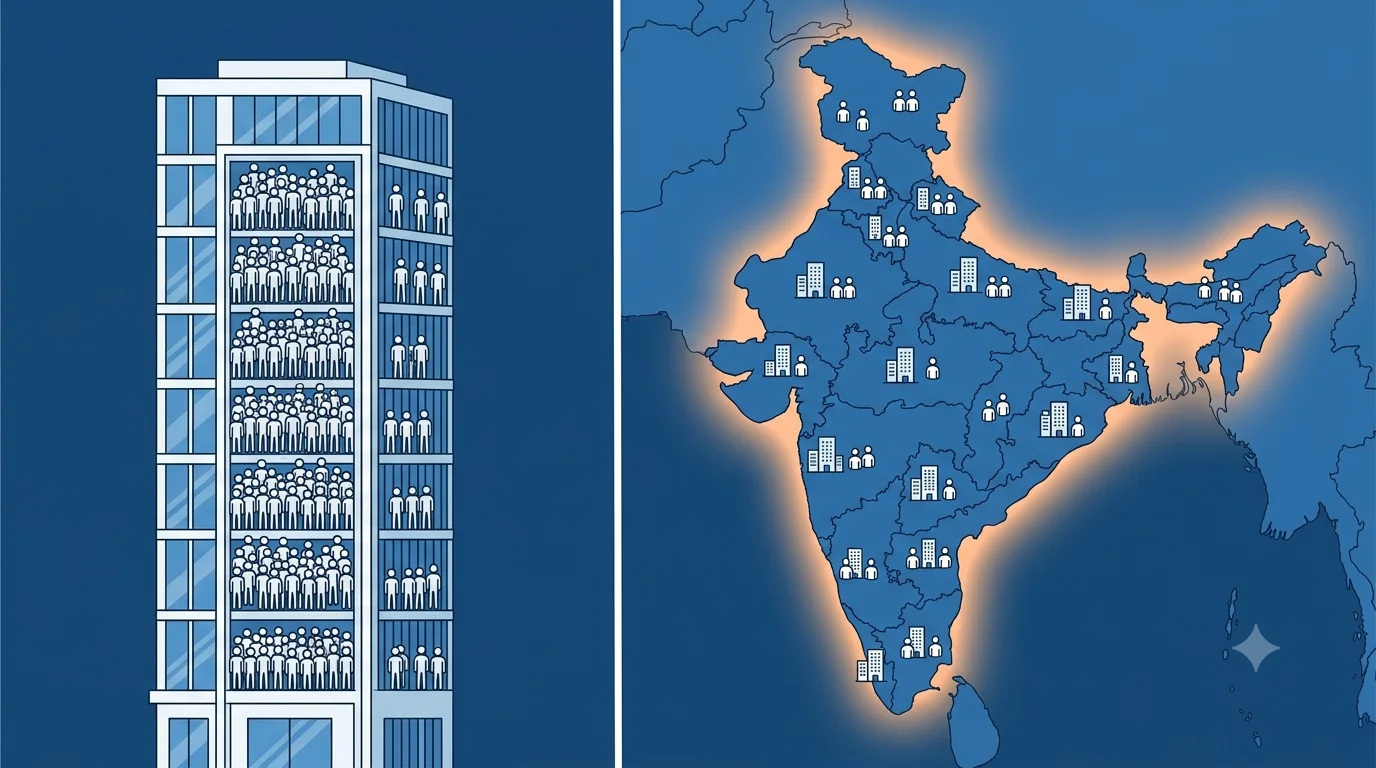
Two Models, One Very Specific Country
Most call center strategy guides are written with a single geography in mind: a country with one dominant language, stable broadband everywhere, and a talent pool concentrated near customers. India is none of those things. A model that works for a Delhi-based lending company will struggle for a logistics firm covering Kerala, Assam, and Rajasthan simultaneously. Before you lock in infrastructure, it is worth understanding what each model actually means and where each one breaks down on Indian soil.
What Is a Centralised Call Center?
A centralised call center puts all agents, supervisors, servers, and telephony infrastructure under one roof, usually in a single city. All inbound and outbound traffic routes to that location regardless of where the customer sits. Management is straightforward: one floor, one team, one set of processes.
This was the default model through the 2000s and early 2010s. It made sense when broadband was expensive and patchy outside metros, when dialers required on-premise hardware, and when most Indian businesses served a relatively homogenous urban customer base. BFSI players set up large floors in Gurugram and Pune. BPOs built campuses in Hyderabad and Chennai. The model delivered genuine economies of scale.
What Is a Distributed Call Center?
A distributed model spreads agents across multiple locations, sometimes across cities or states, sometimes with agents working from home or small satellite offices. All agents connect to a shared cloud platform, share the same CRM, and appear to callers as one coherent team. Supervisors monitor performance remotely through dashboards and call recordings.
The shift to cloud telephony and mobile-native CRM tools made this feasible. A team in Lucknow can log into the same dialer as a team in Coimbatore. Calls are tracked, recorded, and scored centrally. The geography of the agent becomes irrelevant to the customer experience, at least in theory.
Why India Specifically Challenges the Centralised Model
Language Fragmentation
India has 22 scheduled languages and hundreds of dialects. A customer in Kozhikode expects Malayalam. A farmer-borrower in Vidarbha is more comfortable in Marathi or Varhadi. A first-time insurance buyer in rural Odisha may speak Odia with no Hindi at all. A metro-based centralised center staffed primarily with Hindi and English speakers will produce high call drop rates, poor conversion, and frustrated customers the moment you move beyond urban tier-1 markets.
Distributed hiring solves this at source. You hire native speakers in the region you are serving instead of training metro agents in a second language they will never be fluent in.
Talent Geography vs Customer Geography
Metro talent is expensive and churns fast. Average agent attrition in Bengaluru and Gurgaon BPOs runs between 40 and 60 percent annually. Tier-2 cities like Jaipur, Nagpur, Indore, and Bhubaneswar have a growing pool of educated, English-comfortable graduates who accept salaries 30 to 40 percent lower than their metro counterparts and stay longer because fewer competing employers are recruiting actively.
If your customers are in tier-2 and tier-3 towns, the irony of a centralised model is that your agents are the furthest away, culturally and linguistically, from the people they are calling.
Connectivity Is No Longer a Centralised Advantage
The argument for centralisation used to rest partly on infrastructure: good leased lines and reliable power existed only in large cities. That gap has closed significantly. Jio and Airtel 4G coverage reaches most taluka-level towns. Broadband penetration in smaller cities is viable for VoIP. Power backup through UPS for a small satellite office is a solved problem. Cloud dialers run on a stable 10 Mbps connection. The infrastructure case for pulling everyone to one city is much weaker now.
Real Cost Comparison (INR Estimates)
The numbers below are illustrative ranges based on common market rates. Actual figures vary by city and vendor.
| Cost Head | Centralised (Metro) | Distributed (Tier-2 / WFH) |
|---|---|---|
| Agent salary (per month) | Rs. 22,000 to Rs. 35,000 | Rs. 14,000 to Rs. 22,000 |
| Office rent per seat (per month) | Rs. 4,000 to Rs. 8,000 | Rs. 1,200 to Rs. 3,000 (satellite) / near zero (WFH) |
| Attrition-related rehiring cost (annualised per seat) | Rs. 25,000 to Rs. 45,000 | Rs. 10,000 to Rs. 18,000 |
| Training time lost per replacement | 10 to 15 working days | 8 to 12 working days |
| Cloud telephony + CRM (per seat/month) | Rs. 1,500 to Rs. 4,000 | Rs. 1,500 to Rs. 4,000 (same) |
| Leased line / connectivity (per month, 10-seat office) | Rs. 8,000 to Rs. 20,000 | Rs. 3,000 to Rs. 8,000 per satellite location |
For a 50-seat team, the difference in salary and rent alone can reach Rs. 8 to 12 lakh per month. Over a year, that is a meaningful budget that can fund better technology, more hiring, or product investment.
Supervision Trade-offs
This is the sharpest legitimate concern about distributed teams, and it deserves an honest answer.
In a centralised center, a supervisor can walk the floor, overhear calls, spot an agent who is struggling, and intervene in real time. New agent onboarding is faster when everyone is in the same room. Culture is easier to maintain when people share a break room.
In a distributed model, supervision shifts from physical to data-driven. You rely on call recording review, live call monitoring through the dialer, AHT and conversion dashboards, and regular video check-ins. This requires discipline and the right tools. Teams that adopt distributed models without a proper monitoring stack often find that performance drifts quietly before anyone notices.
The answer is not to avoid distribution but to invest in visibility infrastructure before you scale. A cloud CRM with call tracking, disposition tagging, and a supervisor dashboard gives you as much information as walking the floor, sometimes more, because the data is objective and timestamped.
When Centralised Still Wins
- High-compliance, regulated sectors where recorded calls must be audited in person or where data residency rules require physical control over workstations. Certain BFSI and healthcare contexts fall here.
- Complex technical support where agents need dual monitors, specialised hardware, fast escalation to a senior colleague sitting nearby, and access to internal systems that cannot be cloud-hosted.
- Large BPO contracts where the client mandates a dedicated floor with its own network segregation and visible headcount for audits.
- Early-stage teams of under 10 agents where the coordination overhead of a distributed model outweighs the cost savings. It is easier to onboard fast and iterate when everyone is in one place.
When Distributed Wins in India
- Regional language outreach at scale. If you are running loan collections in rural UP, insurance renewal calls in Tamil Nadu, and lead qualification in West Bengal simultaneously, you need native speakers. Distributed hiring is the only practical path.
- High-volume outbound with thin margins. The salary arbitrage in tier-2 cities is real and compounds over time. For teams where the primary metric is calls per agent per day and average handling time, cost per contact drops measurably.
- Pandemic-resilient operations. A team spread across six cities is less likely to go offline entirely due to a local event, infrastructure outage, or public health disruption.
- Sales teams that were originally field-based. If your agents previously visited customers in person and now handle follow-ups remotely, they already know the local market. Letting them work from their home city is a natural fit.
Quick Comparison: Centralised vs Distributed
| Factor | Centralised | Distributed |
|---|---|---|
| Setup cost | High (office, infra, leased lines) | Lower (cloud tools + home/satellite) |
| Monthly operating cost | Higher (metro salaries + rent) | Lower (tier-2 salaries, less rent) |
| Language coverage | Limited to hired language pool | Strong (hire locally per region) |
| Attrition risk | High in metro BPO markets | Lower in tier-2 and tier-3 cities |
| Supervision ease | Easy (physical floor) | Requires good dashboards and discipline |
| Compliance and data control | Easier to enforce on-premise | Needs cloud security + endpoint policy |
| Scale speed | Slower (office capacity limits) | Faster (hire anywhere) |
| Disaster resilience | Single point of failure | Naturally redundant |
| Best for | Compliance-heavy, complex support, large BPOs | Regional outreach, outbound sales, cost-conscious scaling |
A Practical Middle Path
Most Indian businesses that grow beyond 30 to 40 agents end up with a hybrid: a small central team handling quality, training, escalations, and key account calls, while regional clusters or WFH agents handle volume. The central team anchors culture and compliance. The distributed layer handles reach and cost. This is not a compromise, it is a deliberate architecture that matches the reality of India's geography.
The key enabler is a single platform that makes every agent, regardless of location, visible through the same dashboard. Call records, dispositions, follow-up schedules, and performance metrics need to live in one place. Without that, the hybrid model becomes a coordination headache.
If you are building or restructuring a call center team in India and want a platform that works equally well for a centralised floor or a distributed team across cities, start a free trial on Calliyo. It is built specifically for Indian sales and support teams: mobile-first agents, regional language notes, call tracking, and supervisor dashboards in one place.
Frequently asked questions
Is a centralised call center cheaper to run in India?
Not necessarily. Metro office rent and salary costs often make centralised centers more expensive per seat than distributed teams operating from tier-2 cities or a work-from-home setup. For high-volume outbound teams, the salary difference alone between a Gurgaon agent and a Jaipur or Nagpur agent can be Rs. 8,000 to Rs. 13,000 per month per head.
How do you manage quality in a distributed call center?
Quality management in a distributed model depends on technology rather than physical supervision. You need a cloud dialer with call recording, a CRM that logs every interaction and disposition, real-time dashboards for supervisors, and a regular cadence of call audits and video check-ins. Teams that invest in these tools before scaling distributed agents maintain quality as well as centralised floors.
Which model works better for regional language calling in India?
Distributed is significantly better for regional language calling. Hiring agents in or near the target region gives you native speakers who understand local dialects, cultural context, and communication norms. Training metro agents to call in Bengali, Malayalam, or Marathi rarely produces the same conversion rates as local hiring.
Can a small team of 10 to 15 agents use a distributed model?
It is possible but usually not worth the coordination overhead at that size. Teams under 20 agents typically benefit from being co-located during their initial phase so that onboarding, culture-building, and process iteration can happen quickly. Once processes are stable and documented, distributing makes more sense.
What technology do I need to run a distributed call center in India?
At minimum you need a cloud-based dialer that works on mobile and desktop, a CRM with call logging and disposition tracking, a supervisor dashboard with live monitoring and call recording access, and reliable 4G or broadband for each agent. Most cloud CRM platforms designed for Indian teams bundle these features together without requiring on-premise hardware.
Does the distributed model create compliance risks for BFSI companies?
It can, depending on the specific regulation. RBI and IRDAI guidelines around data handling, call recording retention, and customer consent apply equally to distributed teams but are harder to enforce without endpoint policies and cloud security controls. BFSI companies running distributed teams need to ensure call recordings are stored on compliant cloud infrastructure, agent devices meet security baselines, and access to customer data is role-restricted. Many companies in this sector run a hybrid model where sensitive operations remain centralised.