How to Manage a Remote Sales Team Spread Across Multiple Indian States
The hardest part of managing a remote sales team is not the technology. It is the trust problem. When your agents are sitting in front of you, you can tell who is having a good day and who is stuck. When they are in Kanpur and you are in Pune, you are flying blind unless you have deliberately built systems to give yourself visibility.
The managers who get this right do not manage harder. They manage with better information. This post is about what information you actually need, how to get it in real time, and what to do with it.
The four things you need to know about each agent every day
Most sales managers try to track too many numbers. Call counts, talk time, dials per hour, follow-up completion rate, conversion rate, revenue attributed - by the time you have reviewed all of it, the day is over. The agents who needed intervention yesterday are already a day further off course.
Cut it to four numbers per agent, checked daily:
Calls made vs target. Not as a proxy for productivity, but as an early signal. An agent who hits 40% of their daily call target by noon and then disappears is a different problem than an agent who hits 40% by 5 PM but spread it evenly. The pattern matters more than the number.
Connect rate. If an agent's connect rate drops sharply in a given week, something changed. Either the lead quality for their cluster changed, the time-of-day they are calling shifted, or they are cherry-picking easy leads. Each of these has a different fix. Connect rate is the canary.
Conversion rate. Lagging indicator, but the one that matters. Managed weekly rather than daily. A week-on-week drop flags a conversation problem, a script problem, or a lead quality problem. Listening to recordings is the fastest way to tell which.
Follow-up compliance. What percentage of committed follow-ups actually happened on time? An agent who promises callbacks and does not make them is building a leaky pipeline that looks fine until it collapses. This number should be above 90% consistently.
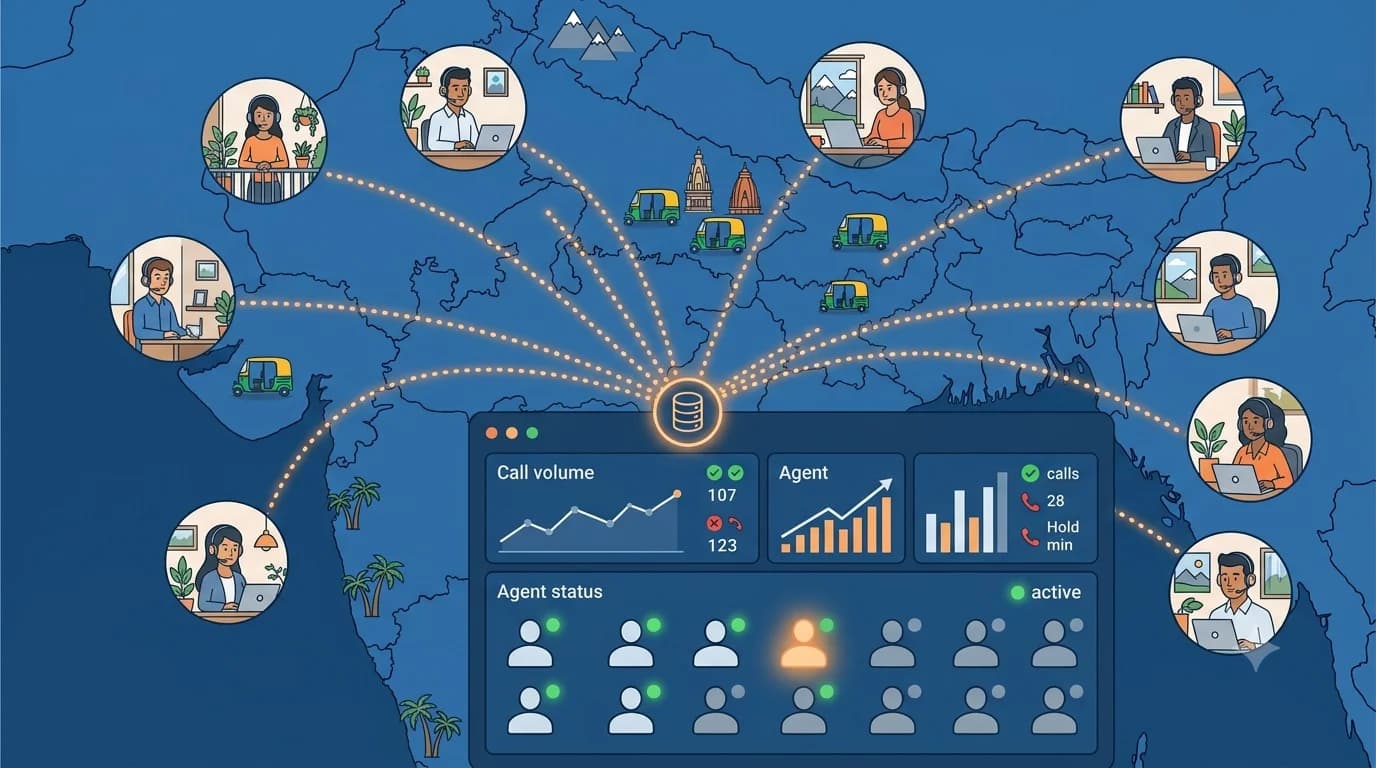
A CRM dashboard that shows these four numbers per agent, updated in real time, replaces most of the supervision that used to require physical presence.
Why real-time visibility beats end-of-day reporting
End-of-day reports create a 24-hour lag between a problem and your ability to fix it. In sales, 24 hours is often a lost deal. A lead that went cold because the agent did not call back by 5 PM is a lead that has answered someone else's call by 9 AM tomorrow.
Real-time visibility means you see call activity as it happens. If an agent in your Lucknow cluster has made no calls by 11 AM, you can message them before noon instead of discovering it in tomorrow's report. If your Ahmedabad cluster's connect rate drops during a specific two-hour window, you can adjust calling hours today instead of analysing it next week.
The shift from daily reports to live dashboards feels like a bigger change than it is. You are not watching agents more intensely. You are just watching things earlier, which means you intervene earlier, which means problems are smaller when you address them.
Building accountability without micromanagement
The failure mode most managers fall into with remote teams is checking in so frequently that agents spend more time reporting than selling. Three check-in calls a day across 20 agents is 60 calls. That is your entire morning.
The alternative is setting targets at the cluster level and letting the CRM dashboard be the accountability mechanism between check-ins. Each cluster (language group, state group, or product line) has a weekly target. The dashboard shows where each cluster is against that target in real time. You intervene when you see a deviation, not on a fixed schedule.
Individual agent targets within a cluster should be set collaboratively, not imposed. An agent who agrees to 30 dials and 3 conversions per day will self-manage against that more honestly than one who had 30 dials handed down from above. The CRM makes the actual numbers transparent to both agent and manager, which removes the incentive to game the reporting.
Coaching at scale with call recordings
The single highest-leverage activity for a distributed sales manager is not meetings or check-ins. It is listening to call recordings. A 10-minute recording session per agent per week, focused on one converted call and one lost call, identifies patterns faster than any other feedback loop.
Listen for three things: where in the conversation did the agent lose control of the narrative? Where did they miss an objection signal? Where did they rush past a moment that deserved more time? Give specific feedback referenced to a timestamp in the recording: “At 3:40, the customer said they need to check with their spouse. You moved straight to features. Next time, pause and ask what their spouse's main concern would be.” That is actionable. “Be more empathetic” is not.
Set a weekly coaching rhythm: review recordings on a fixed day, send written feedback through the CRM or messaging, and schedule a 15-minute call for agents who need conversation. Agents who see that their recordings are actually reviewed take the disposition logging more seriously, which improves your data quality as a side effect.
Onboarding a new agent when you cannot sit next to them
The first two weeks of a remote agent's tenure are the highest-risk period. They do not know the product well enough to answer objections confidently, they are still learning the CRM, and they do not have anyone to ask a quick question to. The instinct is to schedule intensive video calls. This helps, but it is not sufficient.
What works better is a structured first-week protocol:
- Day 1: CRM setup and first 10 practice leads, no live customer calls
- Day 2-3: Shadow recordings - listen to 5 to 10 calls from a top-performing agent in the same language cluster before making their own calls
- Day 4-5: First live calls with a mandatory end-of-day voice note to the manager summarising what they learned
- Week 2: Daily recording review with manager feedback until conversion rate stabilises
The voice note habit is the most underrated part of this. An agent who has to articulate what they learned today processes the day differently than one who just closes their laptop. It also gives you a daily signal about whether they are getting it, without a scheduled call for every agent.
When to intervene vs when to automate
Not every supervision problem needs a manager. A surprising number of the things sales managers spend time chasing can be handled by workflow automation.
Things automation should handle, not managers:
- Missed follow-up reminders: if an agent logged a callback promise for 3 PM and 3 PM passes without a call, a reminder fires automatically
- Status-based SMS to leads: if a call ends without conversion, an automated WhatsApp or SMS goes out with a relevant message
- Lead reassignment after no contact: if a lead has not been called in 48 hours, it automatically reassigns to another agent in the same cluster
- Daily call summary to agents: each agent gets an end-of-day summary of their numbers, automatically
Things that always need a manager:
- A sudden drop in connect rate or conversion rate that does not have an obvious data explanation
- An agent who is consistently below target despite automation nudges
- Unusual customer complaints or escalations
- Onboarding coaching for new agents in the first two weeks
The division of labour here matters. If managers are spending time on things automation can handle, they are not spending time on the things only a manager can do. Setting up the automation once gives you hours of supervision capacity back every week.
A practical weekly rhythm for distributed sales managers
Monday: Review weekly targets by cluster vs previous week actuals. Identify any cluster that is trending below pace and flag for mid-week check-in.
Tuesday/Wednesday: Recording reviews. One converted call and one lost call per agent in rotation (you will not cover all agents every week; rotate through the team over three to four weeks).
Thursday: One-on-one or cluster-level 15-minute calls for anyone who flagged in Monday's review or whose recording raised a coaching point.
Friday: Check follow-up compliance numbers for the week. Any agent below 85% gets a brief conversation about what broke down. Review lead pipeline by cluster for the following week.
This rhythm takes about three to four hours per week for a team of 15 to 20 agents if your CRM is doing the data work automatically. If it is taking more than that, the CRM is not doing its job and you are doing the CRM's job instead.
Calliyo is built for distributed sales management: real-time dashboards across all agent locations, call recordings with disposition logging, workflow automation for follow-ups and lead reassignment, and a mobile-first agent app that works on Android with SIM-based calling. If your current setup has you chasing agents for updates instead of reading a dashboard, start the trial and see what the management side looks like when the data is live.
Frequently asked questions
How many agents can one manager effectively supervise in a distributed remote team?
With a CRM that provides real-time dashboards and call recordings, one experienced manager can effectively supervise 15 to 20 distributed agents. Beyond that, you need either a cluster-level team lead structure or a second manager. The ratio falls apart if the manager is doing manual reporting work that the CRM should handle automatically.
What is the most common failure mode when managing remote sales agents in India?
Agents updating dispositions inaccurately or late, leading to stale pipeline data and missed follow-ups. The root cause is usually that CRM logging feels like overhead rather than part of the selling process. The fix is workflow automation that makes accurate logging the default, not an extra step.
How do you prevent agents from cherry-picking easy leads when you cannot supervise directly?
Lead assignment automation removes the choice. When leads are assigned by the CRM based on cluster, availability, and routing rules rather than agent self-selection, cherry-picking is not possible. Agents work the queue they are given. This also ensures language-matched routing, which improves conversion rates across the whole team.
How long does it take for a new remote agent to reach full productivity?
With a structured onboarding protocol including shadow-call recordings and daily manager feedback in the first two weeks, most agents reach consistent target-level performance by week three or four. Without that structure, the ramp period is often six to eight weeks and the dropout rate in the first month is higher.
Should remote agents use their personal phones for calls?
No. Personal phones create data privacy problems under the DPDP Act, make it impossible to record and review calls for coaching, and mean customer data walks out when the agent leaves. A company-managed SIM on the agent's Android device, tracked through a CRM like Calliyo, keeps the call data in the company's system and protects customer privacy.
How do you handle the time zone and working hour differences across Indian states?
India has one time zone officially, but effective calling windows vary by region and customer profile. The fix is empirical: pull connect rate data by hour of day for each state cluster and build shift schedules around actual answer patterns. A Lucknow cluster might have its best connect window from 10 AM to 1 PM. A Tamil Nadu cluster might peak at 6 to 8 PM. Let the data set the hours, not assumptions imported from metro call center playbooks.