
Lead Management Software: The Complete Guide for Indian Businesses (2026)
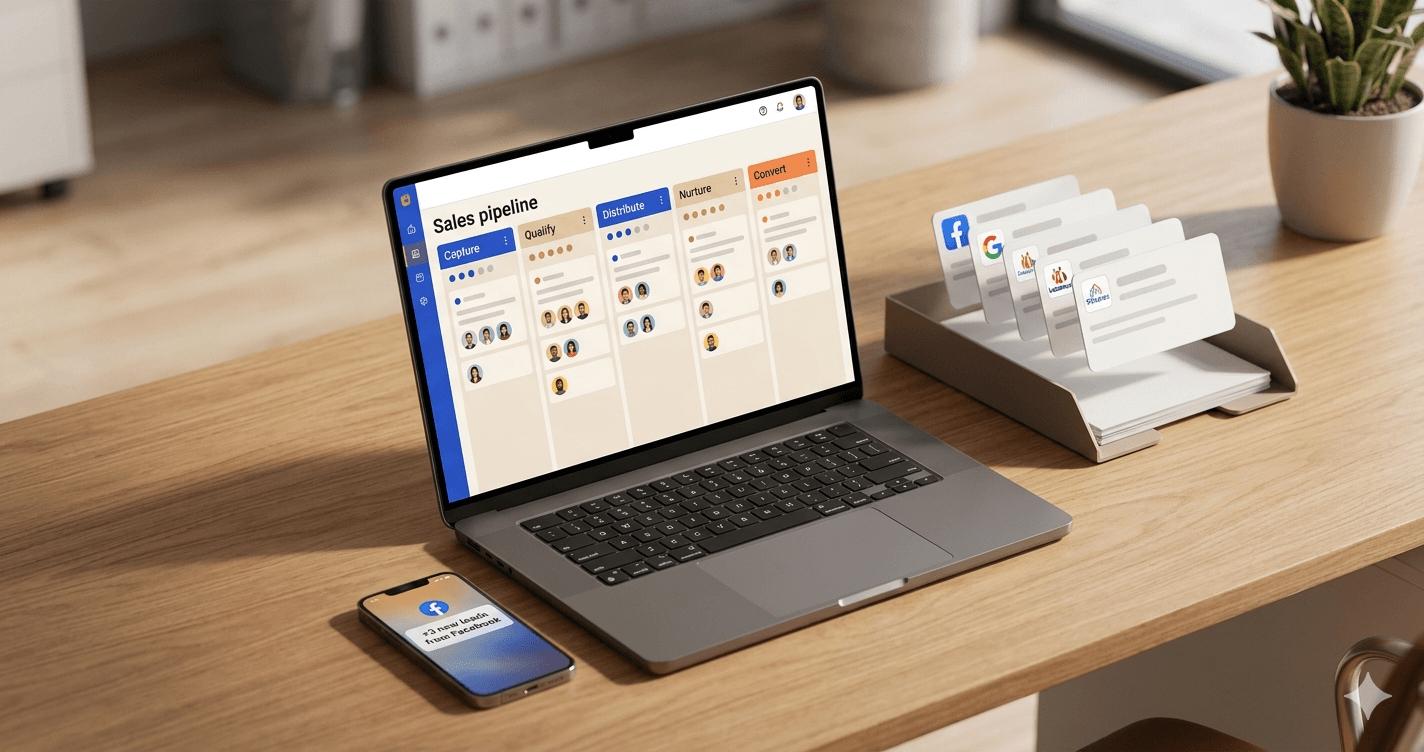
Every business that pays for leads, whether on Facebook, Google, IndiaMart, JustDial, 99acres, or partner referrals, faces the same brutal fact: most of those leads die in the gap between the marketing tool and the salesperson's phone. Industry data shows 30 to 50 percent of paid leads are never even contacted within 24 hours. That is the gap lead management software exists to close.
This guide is the complete picture for Indian SMEs in 2026: what lead management software actually is, the lifecycle it manages, the features that move conversion, how it compares to a CRM, what it costs in INR, the vendor evaluation checklist, common rollout mistakes, and a week-by-week implementation playbook. Built from what we have seen across 500+ Indian SMEs running their lead motion on Calliyo.
What is lead management software?
Lead management software is a system that captures every lead from every source, routes it to the right salesperson in seconds, surfaces the next best action at every stage, and tracks the lead through to closed-won or closed-lost. It is the operational backbone of any business whose sales team works leads.
It is broader than a contact form, narrower than a full CRM. A contact form just stores submissions. A CRM stores a lot more (customer history, support tickets, billing). Lead management is the slice in between, focused exclusively on the funnel from raw lead to qualified opportunity. Most Indian SMEs use the lead management module of a CRM, and many CRM tools are essentially lead management with light extras. See customer relationship management software for the broader category.
The five jobs every lead management system must do
- Capture leads from every source, not just one form on your website
- Distribute leads to the right agent within seconds, automatically
- Track every interaction on the lead, not just the first one
- Surface the next best action for the agent, every day
- Show you where leads are leaking, by source, by stage, by agent
If a tool cannot do all five, it is not a lead management system. It is a contact list with a calendar.
Why Indian SMEs need lead management software in 2026
1. Lead acquisition cost is up, again
Cost per lead on Facebook, Google, 99acres, MagicBricks, and IndiaMart is up 40 to 70 percent versus 2023. When each lead costs 150 to 500 INR to acquire, losing 30 percent of them to forgotten follow-ups is a five-figure monthly leak. The math has flipped: a year ago, a CRM looked like an extra; today, not having one is the costliest line item in your sales operation. Read best CRM software for small business for the buyer view.
2. Speed-to-lead is the new conversion lever
Studies (and our own customer data) show conversion rates triple when a sales team contacts a lead within the first hour versus after 24 hours. The first 5 minutes is the magic window. Without lead management software, hitting that window consistently is impossible. Manual triage cannot move that fast.
3. Indian businesses now buy on multiple channels
The Indian customer journey in 2026 is not linear. They saw your Facebook ad, then googled, then asked a friend, then DMed you on Instagram, then filled a JustDial form. A lead management system reconciles these touchpoints into a single record so your sales rep is not surprised by what the customer already knows.
4. Sales team turnover is high
The average tenure of a frontline telecaller in Indian SMEs is 8 to 14 months. When someone leaves, they take their notebook, their WhatsApp chats, their personal contacts. Lead management software keeps the institutional memory with the company, not the individual. SIM-based CRM takes this further by separating company contacts from personal contacts at the device level.
5. India's regulatory environment is tightening
The DPDP Act now requires consent capture for marketing communications. NPS regulations on financial services, IRDAI guidelines on insurance, and sector-specific rules all expect documented audit trails of lead-to-customer journeys. Spreadsheets do not produce audit trails; lead management software does.
The lead management lifecycle
Every lead, regardless of source or industry, passes through five stages. Lead management software gives you control at each stage.
Stage 1: Capture
Lead arrives from a paid channel, an organic source, a partner, or a walk-in. Source must be tagged automatically so you can attribute conversion later. Capture must be fast: ideally within 5 seconds of the lead's submission, the agent's app should be ringing with the new lead.
The right tool accepts inbound webhooks from any source: web forms, Facebook Lead Ads, 99acres, MagicBricks, IndiaMart, JustDial, NoBroker, Google Forms, Razorpay, partner referrals via API. If manual entry is the only path, expect 30 to 50 percent of leads to never make it into the system.
Stage 2: Qualify
Not every lead is a buyer. Qualification separates the ready-to-buy from the just-curious. The system should let agents tag leads with statuses (Hot, Warm, Cold, Not Interested), and reroute Cold leads into a nurture cadence rather than abandoning them. Operational CRM covers how qualification feeds into the broader funnel.
Stage 3: Distribute
Round-robin is the baseline. Smarter routing considers territory, language preference, working hours, lead source, deal size, agent skill, current workload. The right system lets you write distribution rules without code. Reassignment must preserve all prior history so the new agent does not start cold.
Stage 4: Nurture
Most leads take 3 to 7 touches to convert. The system must automate the cadence: a follow-up call in 2 days, a WhatsApp message at the 1-week mark, an email at the 2-week mark. Sales convincing strategies matter most at this stage; the tool removes the operational friction so the agent can focus on the conversation.
Stage 5: Convert (or Reject)
Closed-won or closed-lost. Both must be captured cleanly so you can analyze why deals close, why they don't, and where the funnel is leaking. Leads that close-lost should not be deleted; they re-enter a long-tail nurture cycle and often convert in the next quarter when their need re-emerges.
Must-have features in lead management software
Vendors will pitch you 200 features. These 12 actually move conversion.
1. Multi-source lead capture via webhooks
Inbound webhooks for any third-party tool. POST to a per-key API endpoint, lead lands in the agent app within seconds, source tagged automatically.
2. Auto-distribution within 5 seconds
The leakage gap is the wait between submission and agent contact. Auto-distribution closes that gap. Round-robin across active agents (skipping leave or banned), with rules for territory and language.
3. Customizable lead status pipeline
Your sales process is not the vendor's default. The system must let you rename, reorder, and add statuses without filing a ticket. Best real estate CRM for lead generation covers an industry-specific example.
4. Auto follow-up scheduling
The system should automatically schedule the next follow-up based on the call outcome. 'No answer' triggers a 2-day callback. 'Interested' triggers a same-day. 'Busy' triggers a 1-hour. Manager dashboard escalates if a follow-up is missed by 24 hours.
5. Real-time dashboard
Live activity feed, agent leaderboards, status-wise pipeline value, today's follow-ups, missed calls, hot leads added today. Drilldowns from any number into the underlying lead list. Email digests at 10 PM tell you about yesterday; by then the deal is gone.
6. Auto call logging
Every call captured with direction, duration, contact, and outcome, with no manual button press from the agent. SIM-based call management, covered in SIM-based calling CRM, makes this nearly invisible to the agent.
7. WhatsApp Business integration
Indian customers reply to WhatsApp 8x faster than email. The lead management system must let agents send templates and free-form messages from inside the lead record using a verified WhatsApp Business number, with conversations logged on the lead timeline.
8. Workflow automation
No-code triggers and actions. 'When lead status changes to Interested, send a WhatsApp template AND schedule a follow-up AND notify the team lead.' Without workflow automation, every customer journey requires a manual step and most agents skip half of them.
9. Lead source attribution
The system must track which source a lead came from, all the way to closed-won. Without attribution, you cannot tell which channel actually drives revenue. Many businesses spend 60 percent of their ad budget on channels that produce 20 percent of revenue, simply because nobody is measuring.
10. Department-aware permissions (RBAC)
A sales head should see their team only. Audit logs of who accessed what data when matter for compliance and for catching internal data leaks (which happen more than you would think).
11. Mobile-first agent app
Your agents work on Android phones, often older models, often in patchy network. The agent app must launch fast, work offline, sync when network returns, and not chew through battery.
12. CSV export and public API
You should never feel locked in. Self-serve CSV export and a public REST API keep your data and your downstream integrations under your control.
Lead management vs CRM vs marketing automation
The terminology overlap kills good purchases. Here is how the categories actually differ.
| Aspect | Lead management | CRM | Marketing automation |
|---|---|---|---|
| Primary user | Sales reps and managers | Sales, support, account managers | Marketing team |
| Scope | Lead to opportunity | Lead through full lifecycle | Top of funnel, awareness to MQL |
| Calling | First-class | Bolt-on telephony | Rare |
| Email campaigns | Light | Medium | Heavy |
| Indian SME pricing (per agent / month) | ₹99-500 | ₹500-4,000+ | ₹2,000-10,000 |
| Best for | Calling-led sales teams | Account-led sales, large customer base | Content-led demand gen |
For most Indian SMEs in 2026, especially those running 5 to 50 sales agents on the phone, a SIM-based call management CRM doubles as a complete lead management system. It captures leads, distributes them, tracks calls, schedules follow-ups, and runs workflows, all in one tool at one price. Call management CRM covers this combination in depth.
The ROI math: what lead management software saves a 10-agent team
Without lead management software
- 10 agents handling ~3,000 leads/month from Facebook, IndiaMart, and partner referrals
- Estimated 35 percent leakage from missed follow-ups: ~1,050 leads not contacted in 24 hours
- Of those, 50 percent would have converted with timely contact (industry data): ~525 lost opportunities/month
- Avg deal size ₹8,000: ~₹42 lakh/month opportunity loss in B2C product businesses
- Manager Excel time: 12 hours/week trying to coordinate
- Agent time on data entry: 1 hour/day each = 220 hours/month across team
With lead management software at ₹99/agent/month
- Software: ₹990/month for 10 agents = ₹11,880/year
- Leakage typically halves in 60 days: 525 lost opportunities drops to ~260
- Recovered pipeline: ~₹21 lakh/month in additional contactable leads
- Manager Excel time: 2 hours/week (saves 40 hours/month)
- Agent data entry: ~10 minutes/day with auto-call-logging (saves ~180 hours/month)
The software pays for itself in under a day for any team handling more than 500 leads/month. The bigger story is the recovered pipeline. CRM benefits and drawbacks takes an honest look at where it does NOT pay off.
Industry-specific use cases
Real estate
99acres, MagicBricks, NoBroker, builder microsites, partner referrals. Inbound volume is high, decision cycles are long, follow-up cadence has 5 to 15 touches. Lead management software is non-negotiable. Real estate lead generation software goes deeper into the source mix.
EdTech and coaching
Lead-to-counselling-to-fee-paid pipeline with high inbound from Facebook lead ads. Demo bookings and reminder cadences are leverage points. Drop-off between counselling and fee payment is the leak to plug.
Loan DSAs and insurance agents
Document chasing is the actual work. Pipeline mirrors regulatory steps (KYC, sanction, disbursal, policy issued). High volume of follow-ups per lead. Audit trails matter for RBI / IRDAI inspections.
D2C and B2C product businesses
Facebook lead ads, Instagram DMs, WhatsApp inquiries, website forms, abandoned carts. Mixed channel sources where attribution and speed-to-lead determine ROAS. Customer relationship management software covers this segment.
Service businesses (clinics, salons, repair)
Inbound calls and missed-call alerts dominate. Same-day callback is the entire conversion lever. Lead management software treats every missed call as a lead and routes it to a free agent immediately.
SaaS and B2B SMEs
Lower volume, higher deal value, longer cycles. Lead-to-demo and demo-to-trial-to-paid funnel needs structured nurture, not just one follow-up call. Workflow automation does the heavy lifting between human touches.
Vendor evaluation checklist
Before signing, run every vendor through this list:
- Free trial for 7 days, no credit card, no sales call.
- Inbound webhook for any source. Have your tech person try posting a test lead during the demo.
- Auto-distribution within 5 seconds of webhook receipt. Time it.
- Customizable lead status pipeline. Ask to rename one in front of the salesperson.
- Auto-call-logging with no manual press. Demand a live demo on a real Android phone.
- WhatsApp Business API integration. Templates and free-form, with logs on the lead.
- Workflow automation with at least 4 trigger types.
- Real-time dashboard. Not nightly digests.
- Lead source attribution to revenue. Closed-won by source must be a default report.
- Department-aware permissions. Sales head sees their team only.
- Indian data residency, GST-compliant invoicing. Both in writing.
- Self-serve CSV export and public REST API.
Common rollout mistakes
Trying to capture every source on day one
Don't. Start with your highest-volume lead source (often Facebook Lead Ads or 99acres) for the first week. Get the routing right, then expand to source #2, then #3. Big-bang migrations break trust when something goes wrong.
Not setting up the lead status pipeline before going live
If statuses are still vendor defaults a month in, agents will use them inconsistently and your reports will be garbage. Spend an hour on day one mapping your real sales process to statuses.
Not enforcing the auto-distribution rule
If managers can manually override the distribution and assign leads to favorites, you lose the speed-to-lead advantage. Automation only works if the team trusts it.
Skipping agent training on the mobile app
Frontline telecallers are skeptical of new tools. Show them how the CRM removes their data entry pain BEFORE you ask them to use it. Sales psychology applies inside your own team too.
Not tracking source-level conversion
Most teams measure leads, not conversion-by-source. The right system shows you that 'Facebook Lead Ads' generates 60 percent of your lead volume but only 18 percent of your closed-won revenue, while 'IndiaMart' is the opposite. Without this signal, your ad spend stays misallocated forever.
The implementation playbook (week-by-week)
Week 1: Setup
Sign up, configure lead statuses, import existing leads from Excel/old CRM, install agent app on 2-3 willing phones. Connect ONE lead source webhook (your highest-volume one). Run for 3 days with the volunteers.
Week 2: Pilot expansion
Add the rest of the team. Connect a second lead source. Train managers on the dashboard. Catch issues now, not later.
Week 3: Workflows and nurture
Set up auto follow-up rules, WhatsApp templates, lead routing logic. Configure missed follow-up escalation. Wire in your remaining lead sources.
Week 4: Optimize
Look at three weeks of data. Which source converts best? What time of day gets the best connect rate? Which agent has the lowest connect rate and what is their pattern? Adjust call timing, scripts, and routing based on what you see.
By end of month one, your team should be running 100 percent on the lead management software, with managers checking dashboards more than spreadsheets.
What to look for in a 2026-ready vendor
The market has matured. These should be table stakes by 2026, not optional add-ons:
- WhatsApp Business API integration with template and free-form messaging
- AI call summary on the lead timeline (saves agents 5-10 minutes per call)
- Public REST API and inbound webhooks for any third-party tool
- Workflow automation with multiple triggers and actions
- Indian data residency with documented DPDP Act compliance
- Mobile-first agent app that works on a 4-year-old Android phone
- Department-aware permissions and audit logs
- Real-time dashboards, not nightly digests
- GST-compliant invoicing
- Lead source attribution to revenue
- Self-serve CSV export
Where to go next
For the architectural deep-dive on the calling layer, read SIM-based calling CRM. For the broader category and adjacent tools, see call management CRM and telecalling CRM software. For specific tooling, CRM dialer and CRM software for small businesses cover the calling and SME angles.
Or skip the reading and start a free 7-day trial of Calliyo. The fastest way to see whether lead management software fits your team is to wire one of your lead sources into it, watch the dashboard fill up, and time the speed-to-lead difference yourself.
Frequently asked questions
What is lead management software?
Lead management software captures every lead from every source, routes it to the right agent within seconds, tracks every interaction, surfaces the next best action, and shows you where leads are leaking. It is the operational backbone of any business whose sales team works leads. It is broader than a contact form, narrower than a full CRM.
How is lead management software different from a CRM?
Lead management is the slice from raw lead to qualified opportunity. CRM covers that plus the entire customer lifecycle (support, retention, upsell, billing). For most Indian SMEs running calling-led sales, a single SIM-based call management CRM doubles as both. CRMs are typically priced higher (₹500 to ₹4,000 per agent) than focused lead management tools (₹99 to ₹500).
What does lead management software cost in India?
Focused lead management software in India ranges from ₹99 to ₹500 per agent per month. Generic CRMs with a lead management module cost ₹1,200 to ₹4,000 per agent. Marketing automation suites are higher, ₹2,000 to ₹10,000 per agent. Calliyo starts at ₹125 per user per month (annual) with a 7-day free trial.
How fast should leads reach my agents?
Within 5 seconds of webhook receipt is the gold standard. Studies and our own customer data show conversion rates triple when first contact happens within an hour and drop sharply after 24 hours. Auto-distribution removes the manager-triage delay that kills most lead motions.
Can lead management software integrate with Facebook Lead Ads, IndiaMart, and 99acres?
Yes. A 2026-ready lead management system should accept inbound webhooks from any source: Facebook Lead Ads, 99acres, MagicBricks, NoBroker, IndiaMart, JustDial, Google Forms, partner APIs, and any web form. The lead is in the agent app within seconds, with source tagged automatically for downstream attribution.
How long does lead management software take to roll out?
A focused rollout (one lead source, one team) takes a week. Full team across all sources is typically 3-4 weeks, including agent training, workflow setup, and source integration. Big-bang rollouts on day one usually fail; phased rollouts succeed.
What happens to old leads that close-lost?
Don't delete them. A good lead management system holds closed-lost leads in a long-tail nurture cycle and re-surfaces them when their need re-emerges. Many businesses see 5 to 10 percent of their revenue come from leads that close-lost the first time and re-engaged 6 to 12 months later.
Will my agents actually use it?
Only if the system auto-logs calls without manual button presses, has a fast mobile app, and demonstrably saves agents time on follow-up reminders. If the system creates more work for agents than it removes, they fight it. Pilot with 2-3 willing agents for 3 days before rolling out wide. Frame it as a productivity tool, not a surveillance tool.
How does lead management software handle data security and DPDP compliance?
Reputable vendors store data on Indian servers (residency), encrypt with AES-256 at rest and TLS 1.2+ in transit, capture consent timestamps, provide audit logs, and offer department-aware role-based access control. Calliyo is built with Indian data residency and DPDP-aligned access controls.