Why Your Telecallers Are Making 40 Calls When They Should Be Making 80
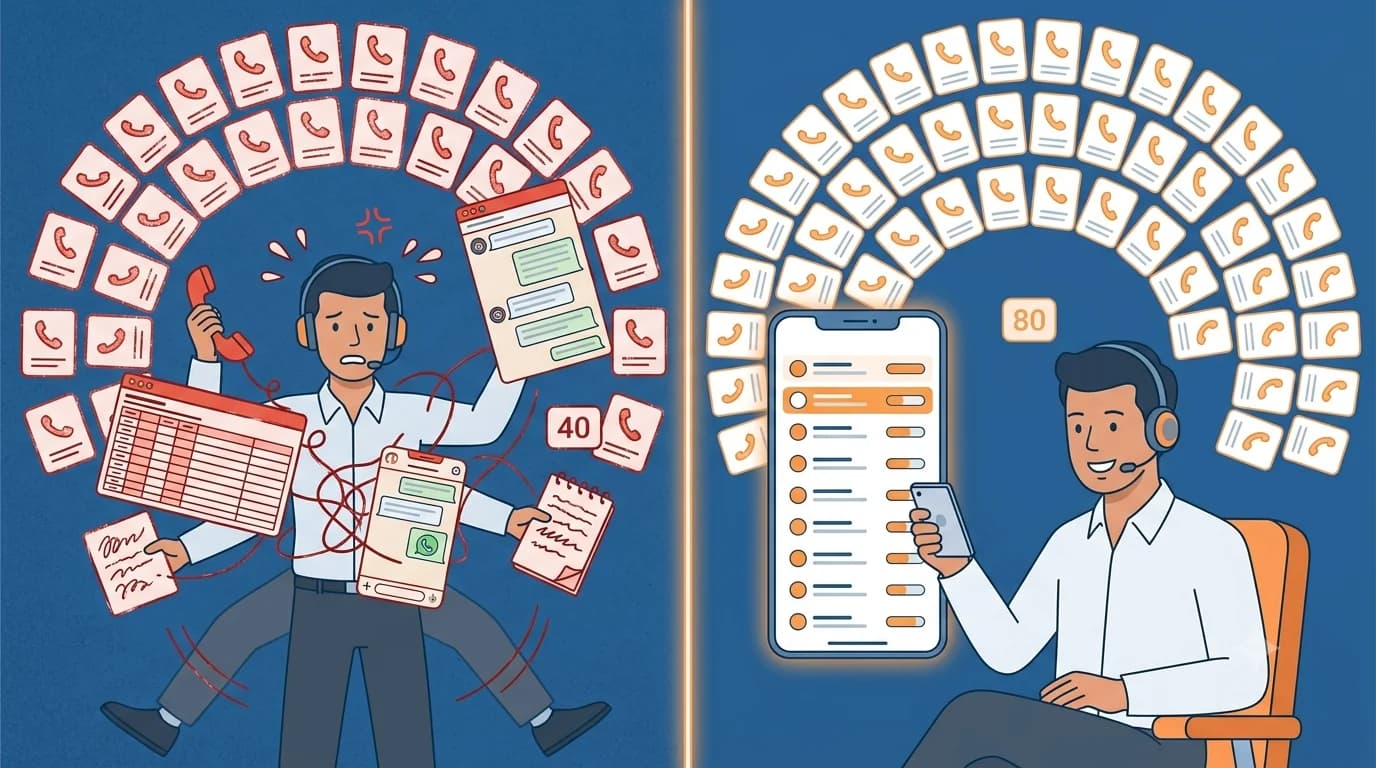
A telecaller's productive unit is the call. Everything that happens between calls is overhead. If a telecaller makes 40 calls in a 8-hour shift, and each call averages 4 minutes, that is 160 minutes on the phone. The other 320 minutes went somewhere. Where it went is the productivity problem.
The answer, in most Indian SME sales teams, is: switching between apps, searching for the next lead to call, manually logging the previous call in a spreadsheet, sending a follow-up WhatsApp from a personal phone, and looking up the customer's previous interaction history before the next call. Each of these takes 3 to 5 minutes. Across 40 calls, that is 2 to 3 hours of avoidable overhead.
The time audit most sales managers have never done
Sit with one of your telecallers for an hour and time every action they take. Not just the calls, but everything in between. What you will typically find:
- 45 to 90 seconds searching the spreadsheet for who to call next
- 20 to 30 seconds dialling manually after finding the number
- 30 to 60 seconds after the call ends, switching to the spreadsheet to update the status
- 60 to 120 seconds writing a note about the call
- 2 to 4 minutes opening WhatsApp, finding the customer, writing and sending a follow-up message
- 30 to 60 seconds finding the next lead and starting the cycle again
Add it up: 5 to 8 minutes of overhead per call. On 40 calls, that is 3 to 5 hours. The same agent with the overhead removed could make 70 to 90 calls in the same shift without working any harder.
What a CRM-first workflow eliminates step by step
Finding the next lead. In Calliyo, the agent opens the app and sees their prioritised call queue. Leads are sorted by priority: new leads first, then overdue callbacks, then follow-ups due today. The agent does not search. They tap the top lead and call.
Dialling. Calliyo initiates the SIM-based call directly from the lead card. One tap. The call goes out from the agent's SIM, not a VoIP line. No manually typing the number, no switching to the phone dialler.
Post-call disposition. When the call ends, Calliyo surfaces the disposition screen immediately on the agent's phone. The agent taps one option (No Answer, Interested, Callback Scheduled, and so on), adds a brief note if needed, and sets the follow-up date and time. This takes 15 to 25 seconds. The call is logged, the lead status is updated, and the follow-up is scheduled, all in the same action.
Follow-up messages. If the lead was marked No Answer, a follow-up SMS fires automatically. If the lead was marked Interested, a WhatsApp with the brochure fires automatically. The agent does not send any message manually. They tap the next lead in the queue and the cycle repeats.
Customer history before the call. When the lead card opens, all previous call history, notes, and WhatsApp threads are visible on the same screen. The agent knows what was discussed last time before the call connects, without switching to another app or searching a spreadsheet.
The maths on recovered calls
Overhead reduced from 6 minutes per call to 30 seconds per call: 5.5 minutes saved per call. Across 40 calls per shift: 220 minutes recovered. That is nearly 4 hours. At 2 minutes per additional call (average call duration for first-touch outbound), that is 110 additional call attempts possible per shift. In practice, the gain is lower because agents need breaks and some calls run long, but the realistic improvement is 30 to 50 additional calls per agent per day.
For a team of 10 telecallers, 40 additional calls per agent per day is 400 additional daily touches across the team. At a 10 percent conversion rate on connected calls, that is 40 additional conversations per day that were previously lost to overhead.
Why agents resist new CRMs and how adoption actually happens
The fastest way to kill CRM adoption is to make logging a call take longer than not logging it. If the agent has to type a 5-field form after every call, they will not do it. They will log calls in batches at the end of the day, by which point half the details are wrong and the timestamps are useless.
Adoption happens when the tool is faster than the alternative. The test: time your agent doing a post-call update in the new system vs what they currently do. If it is faster, they will adopt it without being told. If it is slower, no amount of mandating will produce consistent usage.
Calliyo's post-call flow is specifically designed to be faster than a spreadsheet update. One tap for disposition, optional note, follow-up date, done. The agent is back in the call queue in under 30 seconds. Most agents who use it for a week stop thinking of it as a CRM and start thinking of it as the thing that tells them who to call next.
The manager-side benefit of real-time logging
When agents log calls in a CRM in real time, the manager gets something they did not have before: an accurate, live view of what is happening across the team. Not an end-of-day summary reconstructed from memory. Live data as calls happen.
This changes what a manager can do. Instead of finding out at 5 PM that three agents had low call volumes today, the manager sees it at 11 AM and can intervene. Instead of reviewing a weekly report that aggregates the impact of bad habits, the manager sees individual agent patterns developing in real time and addresses them before they compound.
The manager's productivity improves alongside the agent's because the information is there when it is still useful, not after the fact.
Common objections and why they do not hold
Agents will not use a mobile app. Calliyo is an Android app built for how telecallers actually work: simple screens, large tap targets, minimal text input. Most agents prefer it to a spreadsheet within two weeks because it tells them who to call without them having to figure it out.
Our agents are not tech-savvy. The core flow has three screens: call queue, active call, disposition. An agent who can use WhatsApp can use Calliyo. The learning curve is measured in hours, not days.
We have a spreadsheet that works. A spreadsheet that works for 200 leads stops working at 2,000. The overhead is proportional to lead volume. At the point where it stops working, you will already be behind.
If your telecallers are currently spending half their time between calls instead of on calls, start the Calliyo trial. Run the time audit in week one and compare the numbers to week two after the workflow change. The difference is usually visible within 3 days.
Frequently asked questions
How many calls should a telecaller be making per day?
In a structured 8-hour shift with proper tooling, 70 to 100 call attempts is a realistic target for outbound telecalling. Teams using spreadsheets and manual processes typically land at 40 to 60. The gap is almost entirely overhead between calls, not call duration itself.
Does the Calliyo Android app work on low-end phones?
Yes. The app is designed for Android 8 and above and does not require high-spec hardware. Most agents in tier-2 and tier-3 India using mid-range Android devices in the Rs 8,000 to 15,000 range have no compatibility issues.
What happens if an agent loses connectivity mid-shift?
Call dispositions and notes entered during a connectivity gap are stored locally on the device and sync to the CRM when connectivity is restored. Calls themselves happen over the SIM network, which is independent of data connectivity, so the calling function is unaffected by data outages.
Can agents see their own performance metrics in the app?
Yes. Agents can view their own daily call count, dispositions breakdown, and follow-up compliance from the app. This gives agents visibility into their own performance without needing a manager to run a report, and makes performance conversations more data-driven.
How long does it take for a new telecaller to get productive on Calliyo?
Most agents are independently productive within one to two days of initial setup. The core flow (queue, call, dispose) is simple enough that a brief walkthrough and one supervised session is sufficient. Full feature adoption, including follow-up scheduling and note-taking habits, typically settles by the end of week one.
What if an agent prefers to call from the native phone dialler instead of the app?
Calliyo can detect calls made from the native dialler when the lead is open in the app and log them against the lead record. However, the one-tap calling from the lead card is significantly faster and ensures the post-call disposition screen surfaces automatically. Most agents switch to in-app calling within a few days once they see the time difference.