
Lead Scoring Software: How Indian SMEs Decide Which Leads to Call First (2026 Guide)
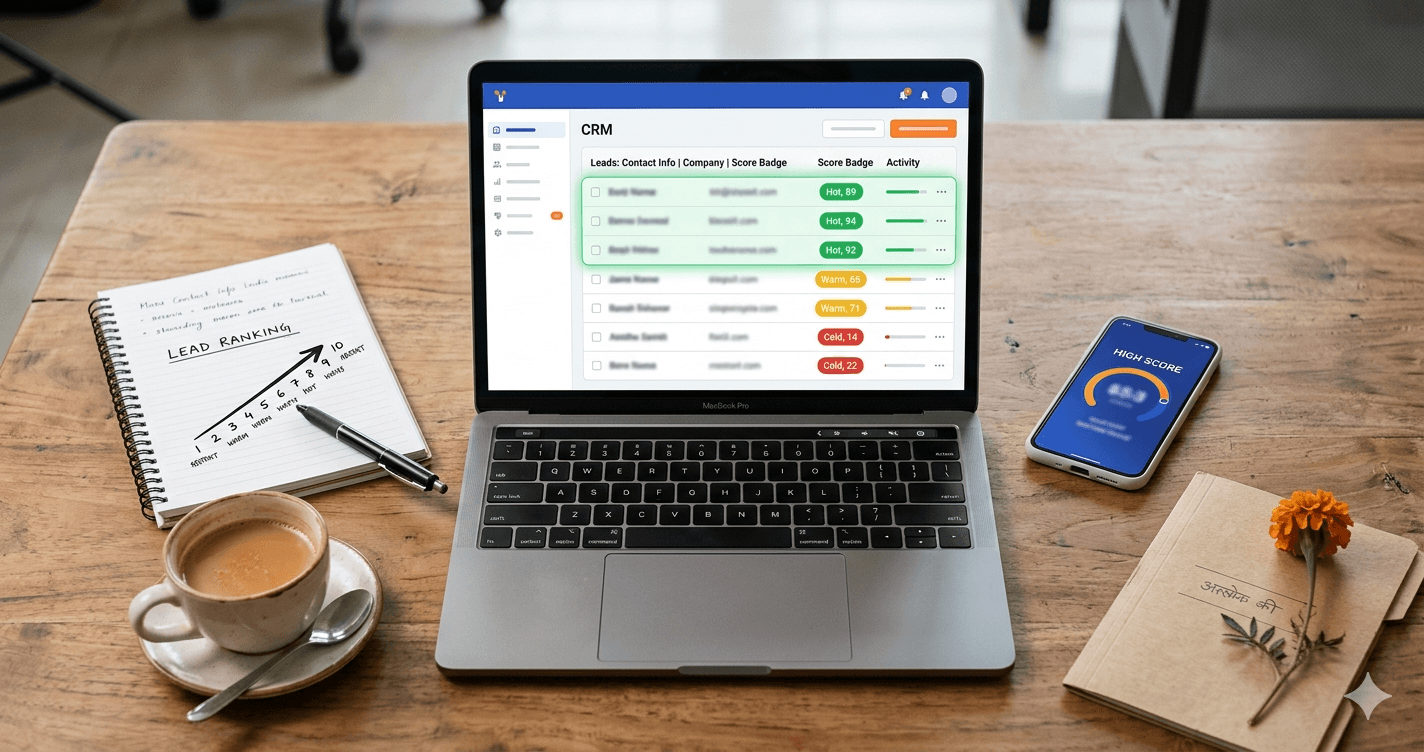
Most Indian SMEs treat every lead the same way. Same script, same priority, same speed of follow-up. That works at low volume. At 100 leads/day it produces an exhausted team and a 4 percent conversion rate. Lead scoring software fixes this by ranking every lead by likelihood-to-convert so your team works the hot ones first.
This guide covers what lead scoring software actually does, the scoring models that fit Indian SME data, how to build a score that is useful without becoming a complicated black box, and where it fits in the broader lead management software stack.
What is lead scoring software?
Lead scoring software assigns a numerical score (typically 0 to 100) to every lead based on signals you define: source, behaviour, demographic fit, engagement history. High-scoring leads (the 'Hot' ones) get priority callbacks; low-scoring leads (the 'Cold' ones) get nurtured but not chased.
The goal is not to predict which leads will convert with mathematical accuracy. It is to give your sales team a simple, defensible signal so they spend their finite attention on the right places. A score of 85 means 'call this one first'. A score of 22 means 'add to the nurture sequence, do not call today'.
For most Indian SMEs in 2026, lead scoring is a feature within their CRM, not a standalone tool. Marketing automation suites have heavy scoring engines; for sales-led SMEs you want a lightweight rule-based score that any salesperson can understand and trust.
Why most Indian SMEs need lead scoring
1. Agent attention is finite
An agent can make ~50 quality outbound calls a day. If you have 200 leads, two-thirds of them are not going to be reached today, period. Scoring decides which two-thirds get pushed to tomorrow's queue.
2. Lead volume from paid channels is rising
Facebook Lead Ads, IndiaMart bulk responders, JustDial inquiries all produce high lead volume at varying quality. Without scoring, your team chases everything equally and the genuinely interested leads get the same effort as the time-wasters.
3. Customers from different sources behave differently
A '99acres premium listing' lead is statistically 5x more likely to close than a 'Facebook Lead Ad' lead in real estate. Same effort on both is a mismatch. Scoring lets you proportion effort to expected return.
4. Agents prioritize wrong without data
Left to their own judgment, agents call the leads with the friendliest-sounding names, the freshest timestamps, or the easiest-to-pronounce details. Score-driven queueing removes the bias and forces attention to the data signal.
The scoring models that work for Indian SMEs
Rule-based scoring (recommended for SMEs)
You define point values for specific lead attributes. Sum the points; that is the score.
Example for a real estate brokerage:
- Source = 99acres: +30 points
- Source = MagicBricks: +25 points
- Source = Facebook Lead Ad: +10 points
- Source = IndiaMart: +5 points
- Phone number is a metro circle (Mumbai/Delhi/Bangalore): +15 points
- Filled the form during business hours: +10 points
- Form mentions 'site visit' or 'budget': +20 points
- Previous lead in CRM from same number (returning interest): +25 points
Score 0-30: Cold. 30-60: Warm. 60+: Hot.
Rule-based is the right starting point. Easy to understand, easy to debug, easy to adjust when conversion data tells you a rule is wrong.
Behavioural scoring
Score adjusts based on what the lead does after capture: opens your email, replies to WhatsApp, requests a callback, visits the pricing page.
Useful but requires that the CRM track behavioural signals (most do not for inbound calling leads). Add this layer after rule-based scoring is working.
Predictive scoring (AI/ML)
Some enterprise CRMs (Salesforce Einstein, HubSpot Predictive Lead Scoring) use ML to predict conversion based on historical data. Powerful but requires thousands of labelled leads to train on. Overkill for most Indian SMEs; the cost-to-value gap with rule-based is large.
Must-have features in lead scoring software
1. No-code rule editor
You should be able to add 'Source = 99acres → +30 points' without filing a ticket. Sales operations needs to tune scores monthly based on what converts.
2. Score visible to agents
The score must show prominently on the lead card in the agent app. Agents should sort their queue by score, descending. If the score is hidden in admin reports, it does not change behaviour.
3. Score-aware routing
Hot leads (score 60+) should auto-route to your top performers or hot-lane team. Cold leads can go to junior agents or a nurture pool. See lead distribution software for the patterns.
4. Score history and tracking
The CRM should record what the score was at lead capture and how it changed over time (e.g. boosted +10 when the customer replied to WhatsApp). Critical for tuning the scoring model.
5. Conversion-by-score reporting
You need a report that says 'leads scored 80-100 convert at 25 percent, 60-80 convert at 12 percent, 40-60 convert at 4 percent, 0-40 convert at 1 percent.' This is the proof that your model is calibrated correctly; without it, scoring is decoration.
How to build a scoring model that actually works
Step 1: Pull 200 closed-won and 200 closed-lost leads from the last 6 months
Look at every attribute: source, location, form fields, time of capture, demographic data. Note which attributes correlate with closed-won.
Step 2: Identify the 5-8 strongest signals
Not 30. Five to eight. Too many rules creates a complicated model that no agent understands or trusts.
Step 3: Assign point values
The strongest signal gets ~30 points. Medium signals get ~15. Weak but useful signals get ~5. Total achievable score should top out around 100.
Step 4: Set thresholds
Three buckets: Cold (0-30), Warm (30-60), Hot (60+). Each bucket gets a different SLA and a different agent pool.
Step 5: Validate against the next 100 leads
Score new leads, track how they convert by score bucket. If Hot leads convert at the same rate as Cold, your model is broken; revise. Most models need 2-3 iterations in the first month.
Step 6: Review quarterly
Channels change, customer behaviour changes. The rule that worked Q1 may not work Q3. Review the conversion-by-score report every quarter, adjust point values.
Common mistakes
1. Overcomplicating the model
30 rules with weights computed by an Excel formula no one can explain. Agents lose trust, scores get ignored. Keep it to 5-8 rules.
2. Scoring on inputs that do not predict conversion
'Email domain is from a Fortune 500 company' sounds important but does not actually predict B2C purchase intent. Score on what your closed-won data shows, not on what feels prestigious.
3. Not showing the score to agents
If the score lives in admin reports but does not appear on the lead card, it changes nothing. Agents need it front and center.
4. No conversion validation
Scoring without checking 'do Hot leads actually convert better than Cold' is faith-based. The validation report is the only way to know your model works.
5. Treating low-score leads as garbage
A score of 20 does not mean 'never contact'. It means 'do not chase, do nurture'. Put them on a long-tail email/WhatsApp cadence and let some re-emerge over 6 months. Lead management software covers nurture flow design.
Lead scoring in different verticals
Real estate
Strongest signals: source (99acres > MagicBricks > Facebook), explicit budget mention, location-property match, returning lead. Hot leads get a 5-minute response SLA.
EdTech and coaching
Strongest signals: source, parent vs student form, course-specific intent, time of capture (parents often fill at night, students during day). Counselling priority should match score.
Loan DSAs and insurance
Strongest signals: documented intent (loan amount, policy type), source (referral > organic > paid), age bracket fit, returning interest. Compliance overlays may force you to contact every lead regardless of score, but scoring still helps order the queue.
B2B SaaS
Strongest signals: company size, role of the form-filler, explicit-intent fields ('we are evaluating...'), behavioural signals (visited pricing page, downloaded case study). B2B is where behavioural scoring genuinely earns its keep.
D2C and product businesses
Strongest signals: source, repeat customer, cart abandonment, price-point fit. Behavioural data from the website often matters more than the lead form itself.
Where to go next
Lead scoring is one layer in a larger lead operation. The full picture: lead management software covers the funnel; lead distribution software covers routing; speed-to-lead covers the urgency of fast response on Hot leads. Together with a strong call management CRM as the operational layer, you have the complete sales-ops stack for an Indian SME in 2026.
Or start a free 7-day trial of Calliyo. The fastest way to validate whether scoring works for your team is to label a week of leads Hot/Warm/Cold based on a simple rule, watch the conversion difference, then build out the model from there.
Frequently asked questions
What is lead scoring software?
Lead scoring software assigns a numerical score (typically 0-100) to every lead based on signals like source, behaviour, demographic fit, and engagement. High-scoring leads get priority callbacks; low-scoring leads get nurtured. The goal is to focus your team's finite attention on leads most likely to convert.
Do small businesses need lead scoring?
If you handle more than ~50 leads per agent per day, yes. Below that, every lead can get equal attention. Above that, you need scoring to decide which leads get worked first. The threshold is when your team starts not being able to call everyone same-day.
Should I use rule-based or AI-based scoring?
For most Indian SMEs, rule-based. It is easy to understand, easy to debug, and easy to tune. AI/ML scoring (Salesforce Einstein, HubSpot Predictive) needs thousands of labelled leads and a data team to maintain. Start with rules; add behavioural signals after that; consider ML only if you scale past 50,000 leads/month.
How many rules should my scoring model have?
Five to eight. Not thirty. More rules creates a complicated model that agents do not understand and therefore do not trust. The strongest signals get ~30 points each; weak signals get ~5. Total achievable score should top out around 100.
What signals should I score on for Indian B2C?
Source (where the lead came from), location/circle of the phone number, form-content signals (budget mentioned, urgency words), time of capture, repeat-lead status. For B2C product businesses also: behavioural signals like cart abandonment or pricing-page visits.
How do I know my scoring model is calibrated correctly?
Pull conversion-by-score reporting. Hot leads (80-100) should convert at 3-5x the rate of Cold leads (0-30). If they convert at the same rate, your model is broken; the signals you weighted highly are not actually predictive. Revise based on your closed-won data.
Should low-scoring leads be deleted?
No. Score of 20 means 'do not chase, do nurture'. Put low-score leads on a long-tail email or WhatsApp cadence and let some re-emerge over 3-6 months. Many B2C businesses see 5-10 percent of revenue from leads that scored Cold initially and warmed up later.
How often should I update my lead scoring model?
Quarterly review minimum. Channels change, customer behaviour changes, your product changes. The rule that worked Q1 may not work Q3. Each review: pull the conversion-by-score report, adjust point values where the predicted vs actual gap is largest, validate against the next month of leads.